The National Bank of Georgia (საქართველოს ეროვნული ბანკი) is the central bank of Georgia and the sole issuer of the lari. It traces its origins to the State Bank of the short-lived Democratic Republic of Georgia (1919–1921), and was re-established in 1991 after independence from the Soviet Union. The lari followed in 1995, replacing the temporary kuponi that had circulated through three years of post-independence hyperinflation.
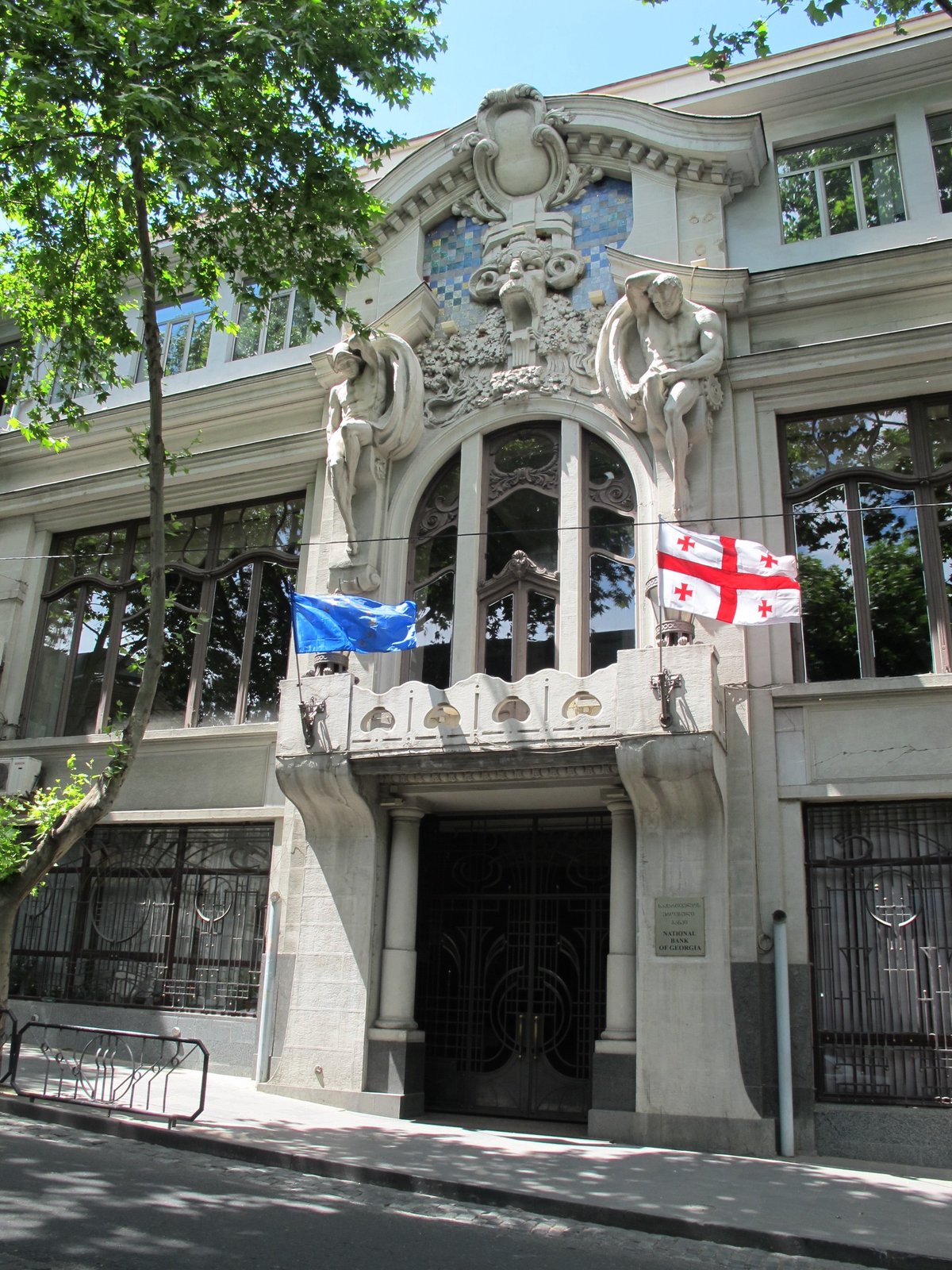
The bank operated from this Art Nouveau building on Giorgi Leonidze Street, a block from Freedom Square in central Tbilisi, until December 2012, when it consolidated its scattered offices into a new headquarters at 2 Sanapiro Street on the right bank of the Mtkvari.
Image: Andrey Romanenko, 2011, CC BY-SA 4.0 via Wikimedia Commons.
Founding (1919)
Georgia's first central bank was the State Bank of the Democratic Republic of Georgia, established on 31 December 1919 in the brief window of post-imperial independence that followed the May 1918 declaration. Its first governor was Yason Lordkipanidze, appointed in July 1920. The bank issued the Georgian maneti (manat) as the national currency, in parallel with notes still circulating from the wartime Transcaucasian Commissariat and the Russian rouble that had not yet been withdrawn.
The Red Army crossed the Georgian border in February 1921 and the Democratic Republic surrendered at Batumi on 18 March. The State Bank was absorbed into the Soviet financial system within months; the manat was withdrawn over the following year and replaced by the chervonets and, later, the Soviet rouble. From 1921 to 1991 monetary authority over Georgia rested in Moscow, with the Georgian Republican Bank of the State Bank of the USSR running day-to-day operations from Tbilisi.
Re-establishment (1991)
After Georgia's restored independence on 9 April 1991, the Supreme Council reconstituted the central bank on the institutional base of the Georgian Republican Bank of the State Bank of the USSR. The new institution took the name National Bank of Georgia and the inherited staff, offices and account ledgers of its Soviet predecessor, but answered to Tbilisi rather than Moscow.
Its formal constitutional status was settled with the 1995 Constitution of Georgia, which declared the National Bank independent of state control and gave it the sole mandate of ensuring price stability. The Organic Law on the National Bank of Georgia, last comprehensively revised in 2009, fills in the operational detail.
Kuponi and the lari (1993–1995)
Between April 1993 and October 1995 Georgia ran on a temporary currency called the kuponi (coupon), introduced as a transitional measure after the Soviet rouble was withdrawn and before a permanent national currency could be designed. The kuponi had no metallic or foreign-currency backing; it depreciated almost on the day of issue. By the end of 1994 a single United States dollar bought over a million kuponi, and the National Bank was reissuing notes in ever-larger denominations roughly every fortnight.
The permanent currency, the Georgian lari, was launched by presidential decree of Eduard Shevardnadze on 2 October 1995 at a conversion rate of one million kuponi to one lari and an initial peg of about 1.3 lari to the US dollar. The lari has held continuously since; the kuponi was demonetised by the end of 1995.
Modern bank
The bank is governed by a seven-member Council, whose members are nominated by the President of Georgia and confirmed by Parliament for seven-year terms. The President of the National Bank is appointed by the President of Georgia from among the Council members; the current Governor is Natia Turnava, a former Minister of Economy and Sustainable Development, appointed in 2024.
Foreign-exchange reserves stood at about US$4.1 billion at the start of 2025. The policy interest rate has held at 7.5 per cent through 2025.
The bank operates from a single consolidated headquarters at 2 Sanapiro Street on the right bank of the Mtkvari, into which it moved in December 2012 from the older offices scattered across the Sololaki and Avlabari districts. The Art Nouveau building on Giorgi Leonidze Street pictured at the top of this page now houses other state functions.