The National Bank of Serbia (NBS, Narodna banka Srbije) is the central bank of Serbia and the issuer of the Serbian dinar. Founded in 1884, it is the oldest financial institution in the country.
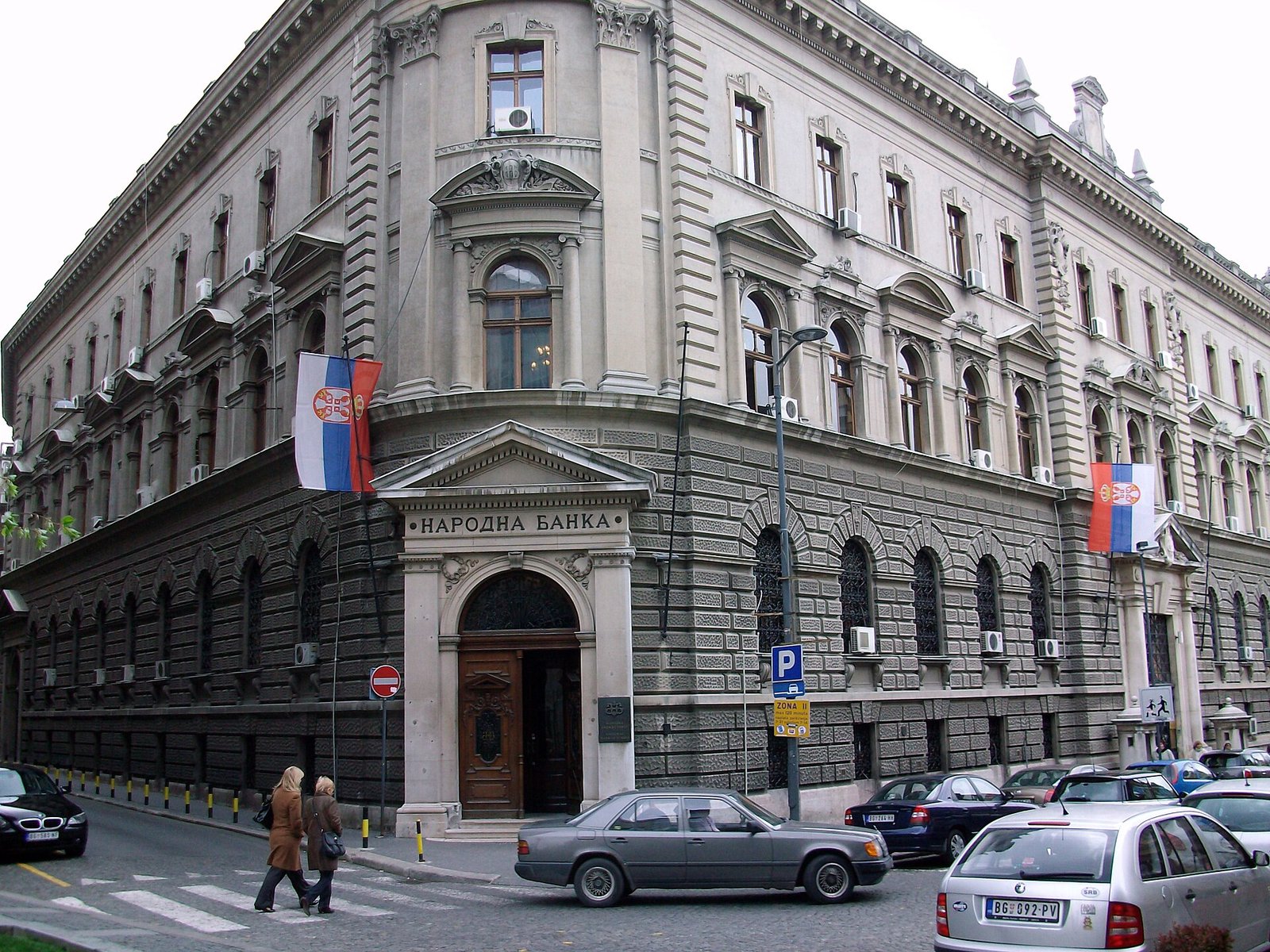
Photo: PedjaNbg, CC BY-SA 3.0, via Wikimedia Commons.
Founding (1884)
The bank was founded by the Law on the National Bank of 18 January 1883 (Julian calendar), four years after Serbia's recognition as an independent kingdom at the Congress of Berlin. Its founding assembly met on 26–29 February 1884, and the doors opened on 2 July 1884 in a rented suite in the Kumanudi brothers' house on Knez Mihailova Street, central Belgrade. The first banknote it issued, also in 1884, was a hundred-dinar note payable in gold.
In 1890 the bank moved into a building it had commissioned itself, the bank palace on what was then Dubrovačka Street (now Kralja Petra Street), designed by the Belgrade-born, Vienna-trained architect Konstantin A. Jovanović. Construction ran from 1889 to 15 March 1890; an extension in the same neo-Renaissance manner was added between 1922 and 1925.
Yugoslav era
The bank lost its separate identity in 1920 when Serbia became part of the new Kingdom of Serbs, Croats and Slovenes, and it spent the next eighty-six years as the federal central bank of successive Yugoslav configurations: the National Bank of the Kingdom of Yugoslavia (1929), of the Federative People's Republic (1946), of the Socialist Federal Republic (1964), of FR Yugoslavia (1992), and finally of Serbia and Montenegro (2003). Through the Second World War it operated in exile, first in Cairo and then in London.
The 1992–1994 hyperinflation
Yugoslavia's currency suffered the second-worst recorded hyperinflation in history between 1992 and 1994, surpassed only by the Hungarian pengő. Inflation peaked at 313 million per cent per month in January 1994; salaries were paid twice a day to keep them ahead of price rises. The highest denomination ever issued was a 500-billion-dinar note signed off in early 1994, worth roughly one Deutsche Mark by the time it reached the street.
Modern bank
After Montenegro's independence referendum of 2006 the federal authority was wound up and its functions devolved to the NBS in its current form. Jorgovanka Tabaković, an economist and former minister, has served as Governor since August 2012, the longest term in the bank's modern history.
The bank's monetary policy aims at price stability; foreign reserves stood at €29.3 billion at the start of 2025. It operates from two buildings: the historic Jovanović palace on Kralja Petra Street and a modern administrative headquarters at 17 Nemanjina Street, completed in 2006 to designs by Grujo Golijanin.