The Magyar Nemzeti Bank (Hungarian National Bank, MNB) is the central bank of Hungary and the issuer of the Hungarian forint. It opened in 1924 to stabilise the post-Trianon Hungarian economy and has issued every forint since 1 August 1946.
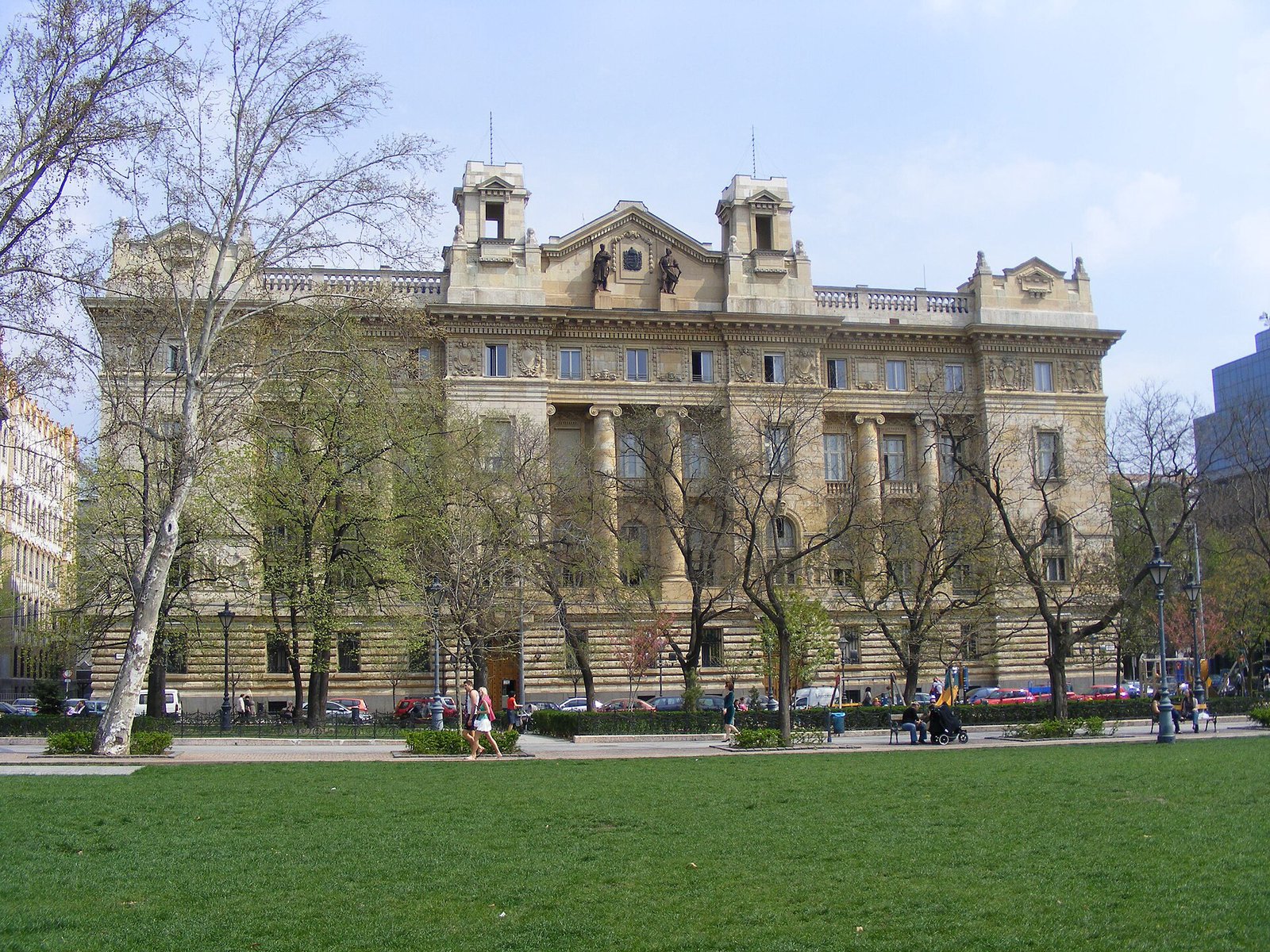
Photo: Egrian, public domain, via Wikimedia Commons.
Founding (1924)
The MNB was established on 24 June 1924 under a stabilisation loan coordinated by the Economic and Financial Organization of the League of Nations. It succeeded the short-lived Royal Hungarian State Bank (1921–1924) and, through it, the Austro-Hungarian Bank dissolved after the Treaty of Trianon.
The first president was Sándor Popovics, who had served as Hungary's Finance Minister in 1918 and as head of the predecessor note-issuing institute since 1921. The bank's headquarters at 8–9 Liberty Square in Budapest is a 1905 neo-Renaissance bank palace by Ignác Alpár, with sculpture by József Róna and Károly Senyei, originally built for the Austro-Hungarian Bank.
The pengő and the 1946 hyperinflation
The MNB's first task was to stabilise the post-war Hungarian crown. In 1927 it replaced the crown with a new currency, the pengő.
The pengő went on to set the worst hyperinflation in recorded history. Between summer 1945 and summer 1946, monthly inflation peaked at 4.19 × 10¹⁶ per cent, with prices doubling every fifteen hours. The MNB printed banknotes in denominations up to 100 quintillion pengő (10²⁰, written 100,000,000,000,000,000,000): the highest face value ever issued for circulation on a banknote, then or since. When the 100-quintillion note entered circulation on 11 July 1946, its purchasing power was about twenty US cents. An even larger one-sextillion-pengő note was printed but never released.
Three weeks later, on 1 August 1946, the MNB issued the forint, exchanging four hundred octillion (4 × 10²⁹) pengő for one forint. The new currency has held continuously since.
Communist era and independence
The bank lost its independence under the 1949 communist banking reform, when central and commercial banking were merged into a single-tier state system. The two-tier system was restored in 1987, and the Act on the National Bank of October 1991 gave the MNB its modern central-bank mandate of price stability.
Modern bank
Hungary joined the European Union in 2004 and the bank joined the European System of Central Banks, but Hungary has not adopted the euro and the MNB continues to issue its own currency.
The current Governor, the former Minister of Finance Mihály Varga, was appointed for a six-year term in March 2025.