The euro (€) is the shared currency of twenty European Union member states and several non-EU territories. It is issued by the European Central Bank in Frankfurt. The banknotes, designed by Robert Kalina of the Austrian National Bank and introduced on 1 January 2002, deliberately avoid depicting real people or places: each denomination is themed around one period of European architecture, with a window or gateway of that style on the obverse and a bridge in the same idiom on the reverse. The series covers seven historical periods, from classical antiquity to the modern twentieth century.
Six of the seven denominations now exist in a refreshed second printing, the Europa series, rolled out by the ECB between 2013 and 2019 with upgraded security features and a watermark portrait of the Phoenician princess who gives the continent its name. The 500 € was not refreshed and stopped being issued in March 2019. For the Europa rollout, the designer Reinhold Gerstetter, and the 500-euro withdrawal story, see The Europa series (2013–2019).
5 €: Classical
The 5-euro note is the smallest in the series at 120 by 62 millimetres and grey-violet in colour. Its theme is classical antiquity, which the European Central Bank dates from the eighth century BC to the fourth century AD.
The obverse shows a stylised classical gateway, flanked by a meander (Greek key) motif and the twelve stars of the European flag. No specific monument is referenced; the gateway is a composite of Doric, Ionic and Roman triumphal-arch forms.
The reverse shows a stylised Roman-style aqueduct, with a map of Europe at the right. The French government has long claimed that the bridge resembles the Pont du Gard near Nîmes. Robert Kalina, designer of the original series, has consistently rejected such national appropriations: "All bridges, windows and doors are virtual; they are just types that represent the individual style."
The note was issued in two series. The first (ES1), designed by Kalina of the Austrian National Bank, entered circulation on 1 January 2002 across the twelve original eurozone states. The second (ES2, the Europa series), redrawn by the Berlin designer Reinhold Gerstetter, replaced it from 2 May 2013 and adds a portrait of the mythological Europa to the watermark and hologram, after an Attic red-figure vase in the Louvre.
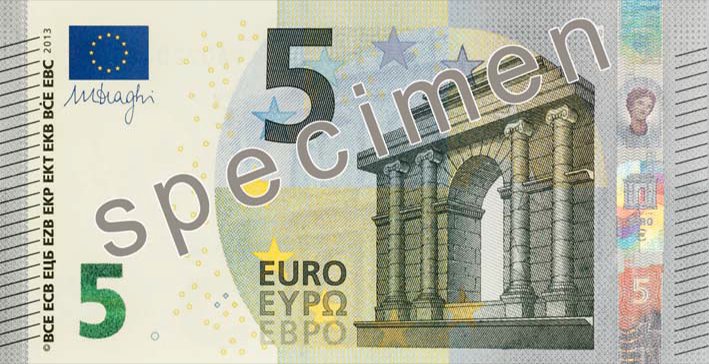
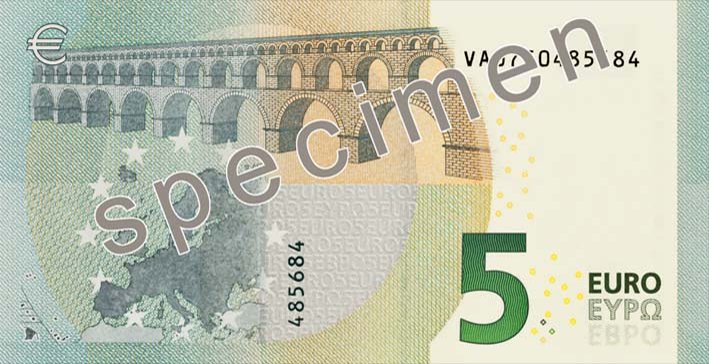
Image: European Central Bank, use permitted under ECB Decisions ECB/2003/4 and ECB/2003/5.
10 €: Romanesque
The 10-euro note measures 127 by 67 millimetres and is red. Its theme is the Romanesque period of the eleventh and twelfth centuries, when stone-vaulted churches, monasteries and bridges spread north from the Mediterranean to the Baltic.
The obverse shows a Romanesque portal: a round-headed arch resting on slender columns with cushion capitals, with the geometric ornament typical of churches such as Speyer, Vézelay or Ripoll.
The reverse shows a stone bridge of multiple equal round arches, of the kind built across European rivers between 1050 and 1200. Spanish and French commentators have variously identified it with the Pont Saint-Bénézet at Avignon (1177) and the Puente la Reina in Navarre (eleventh century); Kalina has continued to insist that no specific structure was intended.
The first series (ES1) entered circulation on 1 January 2002. The Europa series (ES2), redrawn by Reinhold Gerstetter, replaced it from 23 September 2014 and added the portrait of Europa to the watermark and hologram.
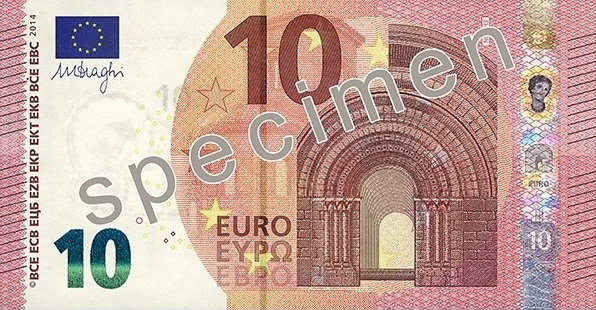
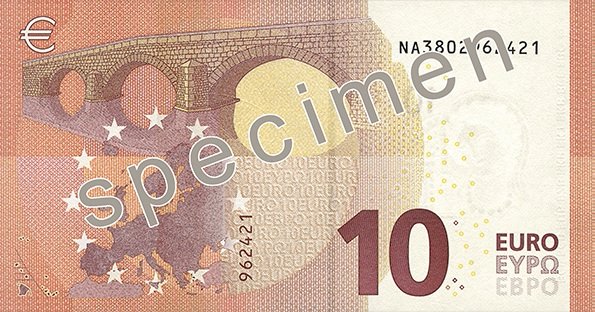
Image: European Central Bank, use permitted under ECB Decisions ECB/2003/4 and ECB/2003/5.
20 €: Gothic
The 20-euro note measures 133 by 72 millimetres and is blue. Its theme is the Gothic period of the thirteenth and fourteenth centuries, the moment when European stonecutters abandoned the round arch for the pointed one and the cathedrals of the north were raised on flying buttresses and rib vaults.
The obverse shows a Gothic pointed-arch window with tracery, of the kind glazed in stained glass at Reims, Chartres or Cologne.
The reverse shows a Gothic bridge of pointed arches over a placid river, with a map of Europe at the right. The closest real-world analogues are the fortified late-Gothic bridges of the fourteenth century: the Pont Valentré at Cahors (completed 1378) or the Charles Bridge in Prague (begun 1357). The note follows none of them in detail.
The first series (ES1) entered circulation on 1 January 2002. The Europa series (ES2), redrawn by Reinhold Gerstetter, replaced it from 25 November 2015 and added the portrait of Europa to the watermark and hologram.
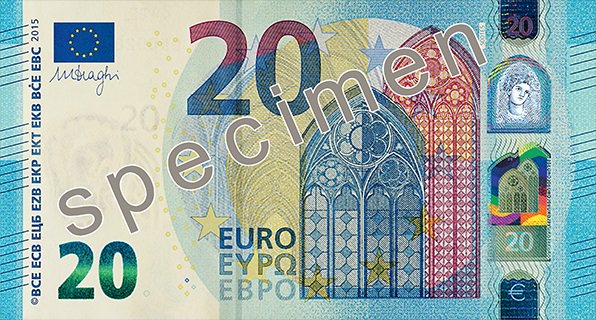
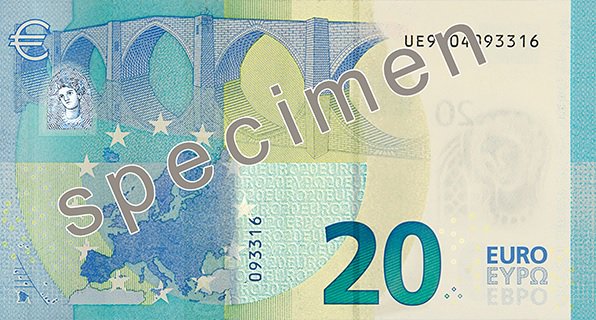
Image: European Central Bank, use permitted under ECB Decisions ECB/2003/4 and ECB/2003/5.
50 €: Renaissance
The 50-euro note measures 140 by 77 millimetres and is orange. Its theme is the Renaissance of the fifteenth and sixteenth centuries, the moment when Italian architects rediscovered the classical orders and exported them across Europe through Bramante, Palladio and their followers.
The obverse shows a Renaissance window with a round arch and pilasters of the kind found in the palazzi of Florence and Rome, framed by a balustrade.
The reverse shows a stone arch bridge with multiple semicircular spans. Robert Kalina's earliest drafts for this denomination were reportedly based on the Rialto Bridge in Venice (Antonio da Ponte, 1591); the European Monetary Institute asked him to dilute the resemblance, and the published design is a Renaissance pastiche rather than the Rialto.
The first series (ES1) entered circulation on 1 January 2002. The Europa series (ES2), redrawn by Reinhold Gerstetter and unveiled on 5 July 2016, replaced it from 4 April 2017, adding the portrait of Europa to the watermark and hologram.
The 50-euro is the most-circulated denomination in the eurozone, accounting for roughly half of all euro notes in circulation.
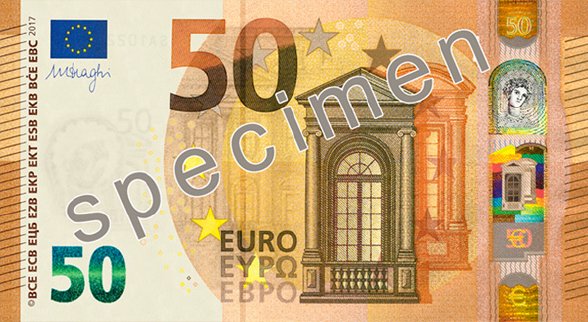
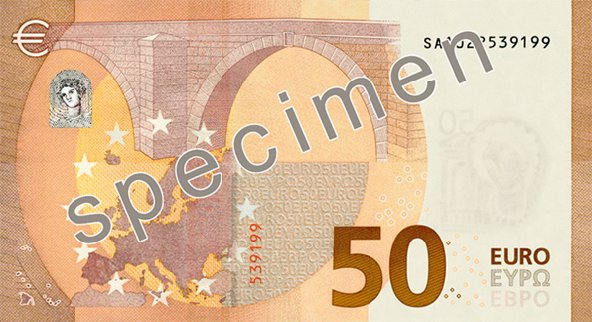
Image: European Central Bank, use permitted under ECB Decisions ECB/2003/4 and ECB/2003/5.
100 €: Baroque and Rococo
The 100-euro note measures 147 by 82 millimetres and is green. Its theme is the European baroque and rococo of the seventeenth and eighteenth centuries, the architectural language of Versailles, Schönbrunn, and the Roman and Salzburg dome-builders.
The obverse shows a baroque window with broken pediment and curling cartouche above, of the kind found on Italian and Viennese palazzi of the period.
The reverse shows a stone arch bridge of multiple equal semicircular spans with rusticated piers, set against a calm river. The composition is closest to Jean-Rodolphe Perronet's Pont de Neuilly outside Paris (1768–1774); journalists have noted that Kalina's earliest drafts of this denomination appear to have been traced from a nineteenth-century lithograph of Perronet's bridge, complete with the boats on the water below and the horse-drawn carriages on the deck above. The published version drops the staffage and softens the resemblance.
The first series (ES1) entered circulation on 1 January 2002. The Europa series (ES2), unveiled on 17 September 2018 and launched together with the 200-euro on 28 May 2019, was again redrawn by Reinhold Gerstetter and adds the portrait of Europa to the watermark and hologram.
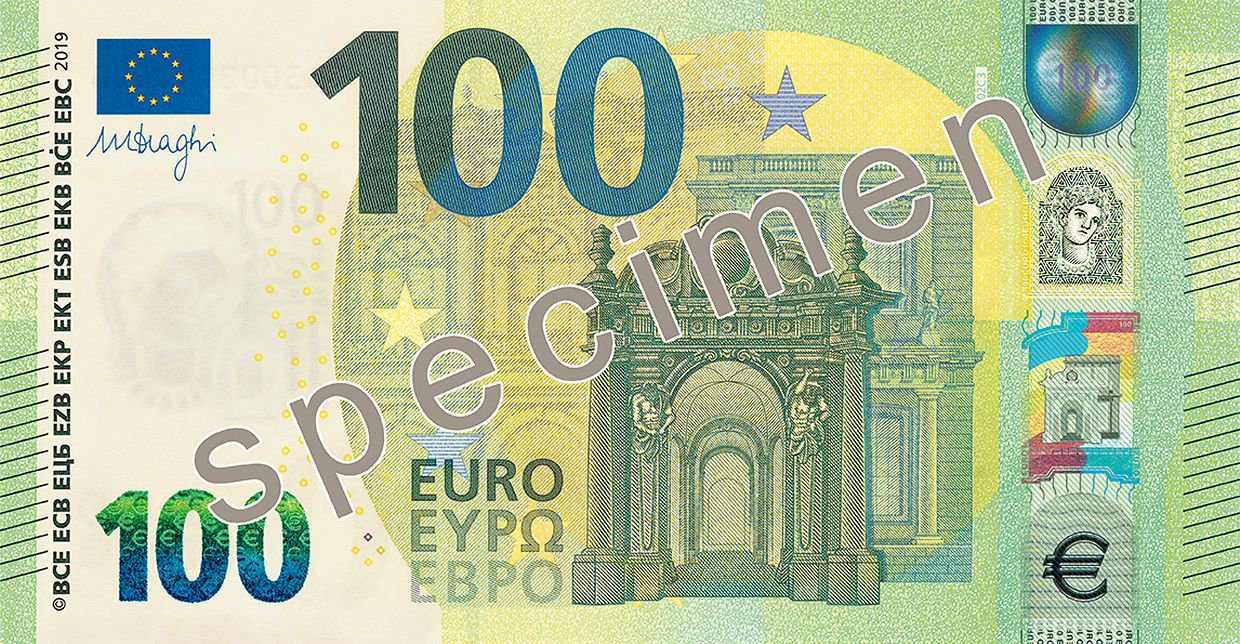
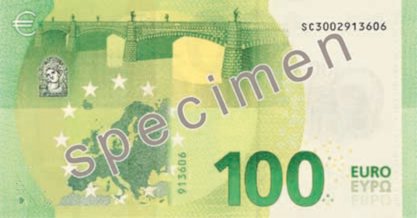
Image: European Central Bank, use permitted under ECB Decisions ECB/2003/4 and ECB/2003/5.
200 €: Iron and glass
The 200-euro note measures 153 by 82 millimetres and is yellow-brown. Its theme is the architecture of iron and glass that came out of the Industrial Revolution and dominated nineteenth-century engineering, from the great railway sheds to the Crystal Palace and the iron bridges of the second half of the century.
The obverse shows an Art Nouveau window with floral iron mullions and stained glass, of the kind built by Victor Horta in Brussels and Hector Guimard in Paris around 1900.
The reverse shows an iron arch bridge with riveted spandrels, the kind put up across European rivers and railways from the Iron Bridge at Coalbrookdale (1779) onwards. As with the other denominations, the bridge represents the period rather than any specific structure.
The first series (ES1) entered circulation on 1 January 2002. The Europa series (ES2), redrawn by Reinhold Gerstetter, launched on 28 May 2019 alongside the new 100-euro and added the portrait of Europa to the watermark and hologram.
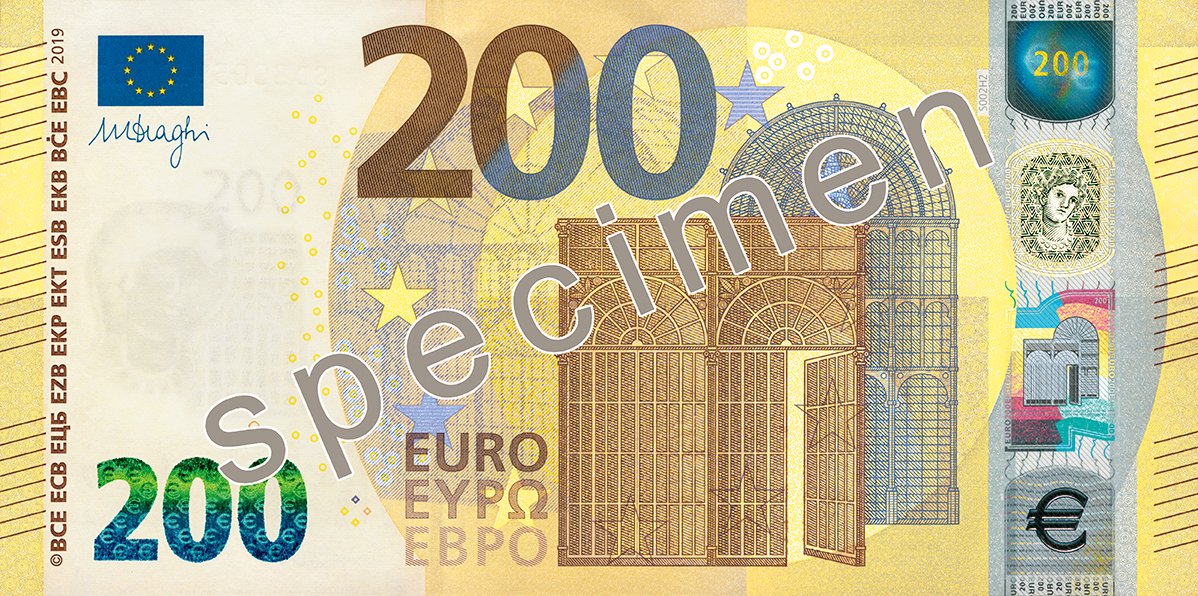
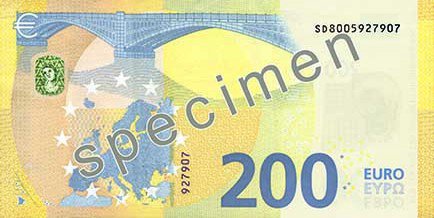
Image: European Central Bank, use permitted under ECB Decisions ECB/2003/4 and ECB/2003/5.
500 €: Modern 20th century
The 500-euro note measures 160 by 82 millimetres and is purple. The largest banknote in the series, it took its theme from twentieth-century modernism: minimalist geometry, glass curtain walls, and the cable-stayed bridges that came to dominate civil engineering after the Second World War.
The obverse shows a stylised modernist window framed by horizontal mullions, of the sort used by Le Corbusier, Mies van der Rohe and their followers from the 1920s onwards.
The reverse shows a cable-stayed bridge with a single central pylon, a type pioneered in the Strömsund Bridge in Sweden (1956) and made common by the long German Rhine crossings of the 1960s, the Pont de Normandie (1995) and Norman Foster's Millau Viaduct (2004). Like the others in the series, the bridge belongs to no specific structure.
The note acquired the nickname "Bin Laden" in the years after 2001: enormous value packed into the same small footprint of cotton fibre, useful to anyone with cash to move quietly. In 2016 the European Central Bank announced that issuance would stop, citing concerns over money laundering and the financing of terrorism; the last notes had been printed in 2014. Most eurozone central banks ceased issuing it on 26 January 2019, with the Bundesbank and the Austrian National Bank holding out until 27 April. The note remains legal tender indefinitely and is exchangeable for life at any eurozone central bank.
Because the 500-euro was being withdrawn while the Europa series was being designed, it is the only denomination of the original series never redrawn. The images above are from the only series ever issued.
A coda to the story of the whole euro design: the Dutch designer Robin Stam built all seven of Robert Kalina's "fictional" bridges as real concrete footbridges across canals in the town of Spijkenisse outside Rotterdam between 2011 and 2013, the 500-euro cable-stayed bridge among them.
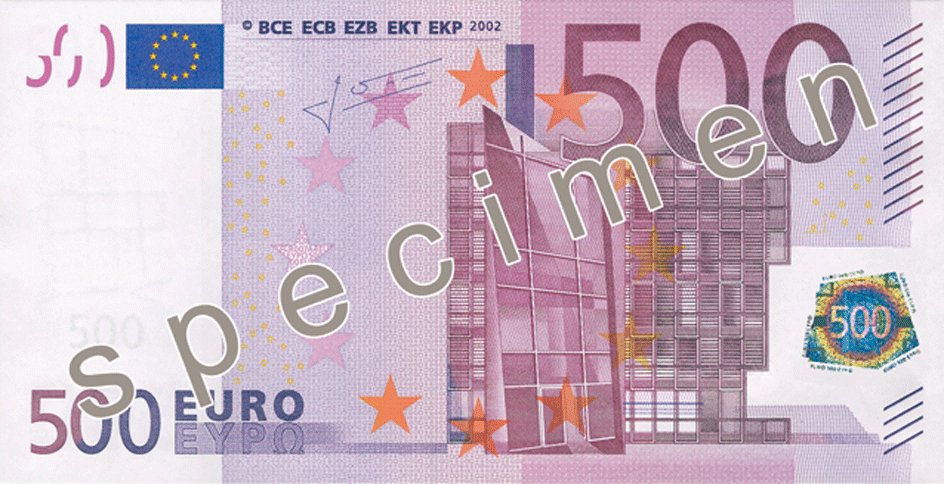
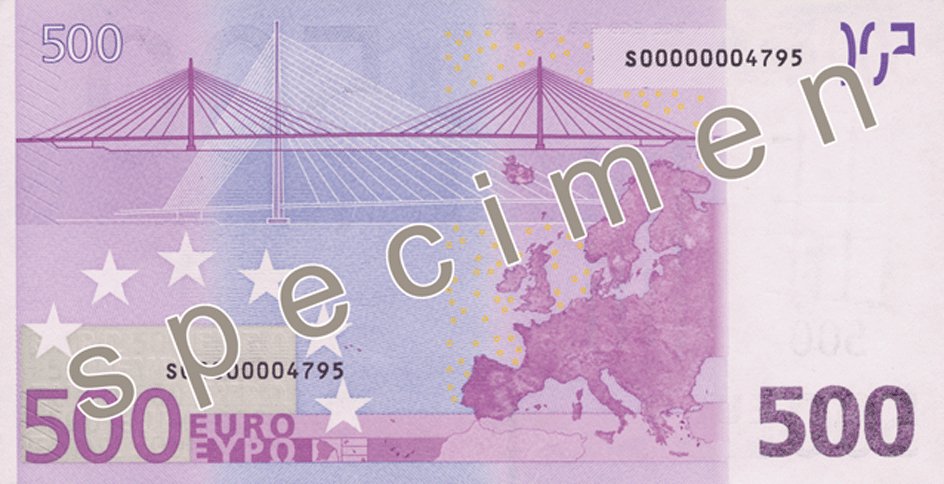
Image: European Central Bank, use permitted under ECB Decisions ECB/2003/4 and ECB/2003/5.