The current series of Hungarian forint banknotes was introduced by the Magyar Nemzeti Bank between 1997 and 2001 and refreshed with upgraded security features between 2014 and 2019. Its six denominations honour figures from a thousand years of Hungarian political history: a sainted king who founded the state, a Renaissance ruler, two Transylvanian princes, the noble who modernised the country, and the lawyer who negotiated its compromise with the Habsburg empire. Each reverse shows a building or scene tied to the figure on the front.
The 1997 originals and the 2014–2019 refresh share the same portraits and scenes; the refresh added wider security strips, larger watermarks, colour-shifting ink, and a notable shift from orange to red on the 500-forint. For the designer, printer, paper mill and the year-by-year rollout, see The current series (1997–2019).
500 forint
Obverse: Ferenc II Rákóczi
Ferenc II Rákóczi (1676–1735) was the richest landowner in the Kingdom of Hungary and the last prince to lead a full-scale Hungarian uprising against Habsburg rule. He was born into a family of armed resistance: his father died when he was four months old, and his mother Ilona Zrínyi later defended Munkács Castle against imperial troops for three years, surrendering only in 1688.
The boy spent his teens as a ward of Emperor Leopold I, schooled by Jesuits in Bohemia and Austria, and returned to his estates a courtier. By 1703 he had emerged as the reluctant commander of the Kuruc rebellion. Within months his army held most of Hungary east and north of the Danube; the Diet of Szécsény elected him "ruling prince" in 1705, and the Diet of Ónod formally deposed the Habsburgs in 1707.
The French alliance he had counted on dissolved after Blenheim, his copper currency lost the confidence of a silver-trained economy, and after the rout at Trencsén in 1708 the war wound down to the Peace of Szatmár in 1711, signed by his deputy Sándor Károlyi while Rákóczi was already in Poland.
He refused the amnesty, passed through France, and spent his last eighteen years in Tekirdağ on the Sea of Marmara, in a routine of morning Mass, writing, and carpentry, until his death in 1735. His remains were not allowed home until 1906, when they were reinterred in the Cathedral of Saint Elisabeth in Kassa (Košice).
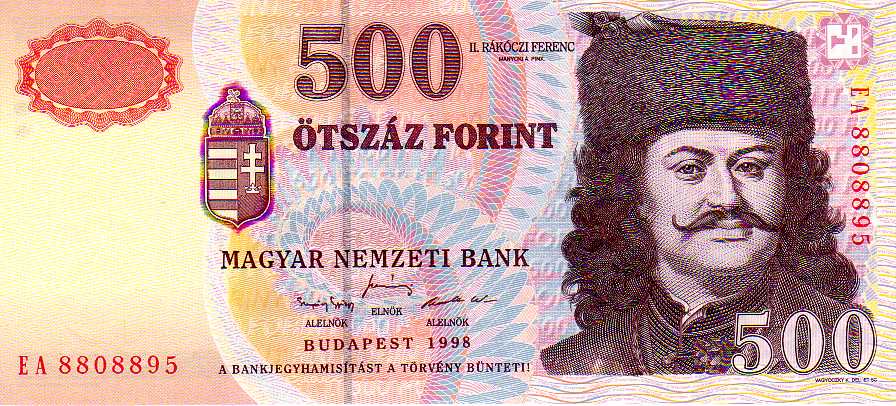
The portrait reproduces Ádám Mányoki's 1712 painting of the Prince, the canonical likeness commissioned during Rákóczi's diplomatic mission in Danzig and now in the collection of the Hungarian National Gallery.
Image: Magyar Nemzeti Bank, released for unrestricted reproduction within the limits of Hungarian anti-counterfeiting law.
Reverse: Sárospatak Castle
The reverse pairs the prince with his family seat. Sárospatak Castle, in the wine country of north-eastern Hungary, was founded as a royal fortress under King Andrew II in the early 13th century and passed through the Pálóczi, Perényi and Dobó families before entering the Rákóczi estate in 1616 through the dowry of Zsuzsanna Lorántffy.
The east wing (including the five-storey Renaissance Red Tower and the loggia named for Lorántffy) was built in the first half of the 17th century, and the building survives as one of the most complete late-Renaissance noble residences in Central Europe.
On its second floor, the small balcony-room known as the Sub Rosa, named for the rose-stuccoed boss in the centre of its umbrella vault, hosted the secret meetings of the Wesselényi conspiracy against the Habsburgs in 1666, during the wedding of Ferenc I Rákóczi to Ilona Zrínyi, Ferenc II's parents.
The castle later served as a stronghold of Ferenc II Rákóczi's war: a session of the rebel Diet met in its halls in 1708, months before the catastrophe at Trencsén. The Habsburgs confiscated the estate in 1711; after centuries of changing hands it was nationalised in 1950 and now houses the Rákóczi Museum, a branch of the Hungarian National Museum.
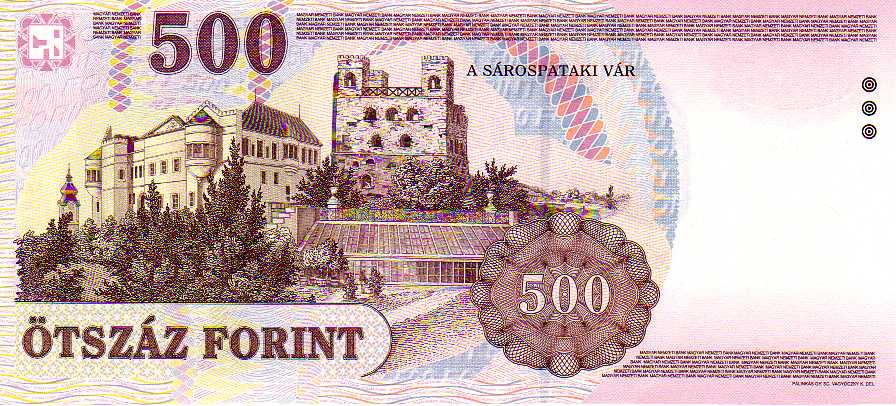
A view of the castle's main façade, with the Renaissance Red Tower at left, dominates the note.
Image: Magyar Nemzeti Bank, released for unrestricted reproduction within the limits of Hungarian anti-counterfeiting law.
1,000 forint
Obverse: Matthias Corvinus
Matthias Corvinus (1443–1490), the second king of the Hunyadi line, presided over Hungary's brief Renaissance and the only period in which the kingdom dictated terms to its neighbours.
He was the son of János Hunyadi, the regent who broke the Ottoman siege of Belgrade in 1456, and was elected king at fourteen in 1458 as a compromise candidate, after his older brother László had been executed and the boy-king Ladislaus the Posthumous had died without heirs. He was crowned in 1464 with the Holy Crown of Hungary, which his predecessors had had to ransom back from Emperor Frederick III.
Matthias raised one of the first standing armies outside Italy, the Black Army (Fekete Sereg), and used it to subdue the Czech mercenary captains of the Upper Tisza, to take Silesia and Moravia from George of Poděbrady, and finally to capture Vienna in 1485, moving his court there as titular Duke of Austria. He codified the courts in the Decretum maius of 1486 and reorganised tax collection.
In 1476 he married Beatrice of Naples, who brought Italian humanists, sculptors and book-illuminators in her train. He assembled the Bibliotheca Corviniana, one of Europe's largest royal libraries before its scattering.
He died in Vienna at forty-seven in April 1490 without a legitimate male heir; his empire fragmented within months and the Black Army was disbanded. In Hungarian folklore he survived as Mátyás az Igazságos, Matthias the Just, a king who wandered in disguise to dispense justice among his subjects.
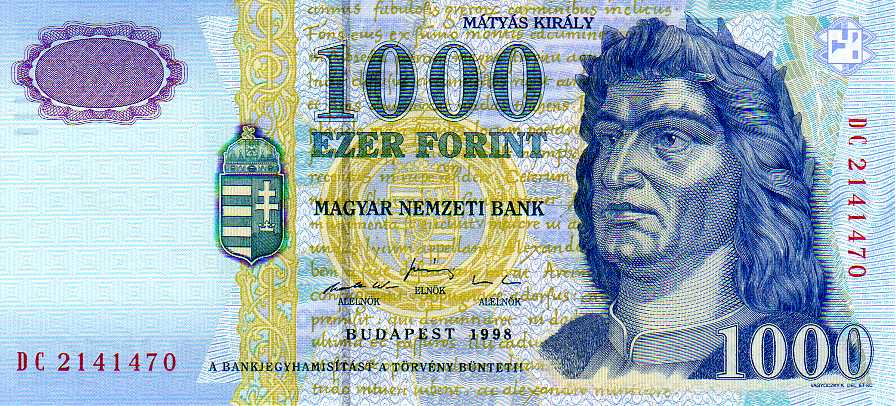
The portrait follows a contemporary fifteenth-century likeness of the king, of a type recorded in Corvina manuscript miniatures and on coins struck during his reign.
Image: Magyar Nemzeti Bank, released for unrestricted reproduction within the limits of Hungarian anti-counterfeiting law.
Reverse: Hercules Fountain at Visegrád
The reverse pairs the king with the centrepiece of his summer residence. The Royal Palace of Visegrád, on a terrace above the Danube Bend, was founded by Charles I of Anjou after 1325 and expanded by Louis the Great and Sigismund of Luxembourg into a square complex some 123 metres on a side.
Between 1477 and 1484 Matthias had it rebuilt as a Gothic-Renaissance hybrid, importing the masons and marble carvers his Italian wife had brought into her train, among the first works of Italian Renaissance architecture executed outside the peninsula.
The Hercules Fountain stood in the upper courtyard, cut from Hungarian red marble around 1484 by the Dalmatian sculptor Giovanni Dalmata. Its central group shows the young Hercules in combat with the Hydra, a coded portrait of the king himself, who used the hero as his personal device.
The palace was sacked after the Ottoman conquest of Visegrád in 1544, the fountain shattered, and the site lay buried under landslide debris until the archaeologist János Schulek began its excavation in 1934. The fragments have since been reassembled at the King Matthias Museum on the original site.
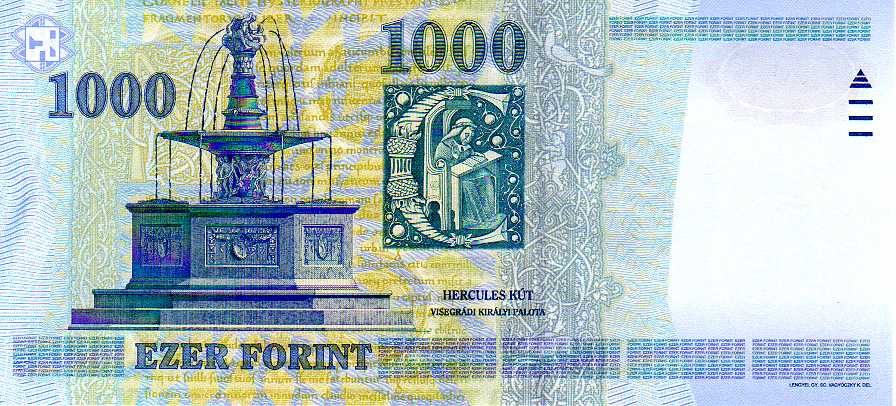
The reassembled fountain dominates the note; an inset reproduces a decorated initial from one of the Corvina manuscripts.
Image: Magyar Nemzeti Bank, released for unrestricted reproduction within the limits of Hungarian anti-counterfeiting law.
2,000 forint
Obverse: Gábor Bethlen
Gábor Bethlen (1580–1629), Prince of Transylvania from 1613 until his death, was the only man ever elected King of Hungary in his own right and the leading Protestant power in seventeenth-century Central Europe.
Born to a Calvinist family that had lost its lands to Ottoman expansion, he came to power as an officer in István Bocskai's anti-Habsburg uprising, fled to Ottoman service after Bocskai's death, and returned in 1613 when the Sultan installed him as prince of the rump principality and the Transylvanian Diet confirmed the appointment. The 1615 Peace of Tyrnau secured Habsburg recognition.
As the Thirty Years' War broke out he led three campaigns into Royal Hungary (1619, 1623, 1626), allied alternately with the Bohemian estates, the Ottomans and the Protestant Union. In 1619 he occupied Bratislava, took possession of the Holy Crown, and was elected King of Hungary by the Diet of Besztercebánya in 1620, though he was never crowned.
The 1621 Peace of Nikolsburg ended his royal title in exchange for seven counties of north-eastern Hungary, a hereditary princedom in the Empire, and Habsburg recognition of religious freedoms for Hungarian Protestants.
At his capital of Gyulafehérvár (today Alba Iulia) he nationalised mines and foreign trade, founded the Collegium Academicum in 1622, and recruited Johann Heinrich Alsted, Johann Heinrich Bisterfeld, Ludwig Philipp Piscator and the German poet Martin Opitz to lecture there.
He married first Zsuzsanna Károlyi and, after her death in 1622, Catherine of Brandenburg, sister-in-law to Gustavus Adolphus of Sweden. He died at Gyulafehérvár on 15 November 1629; Transylvanian historiography treats his reign as the principality's golden age.
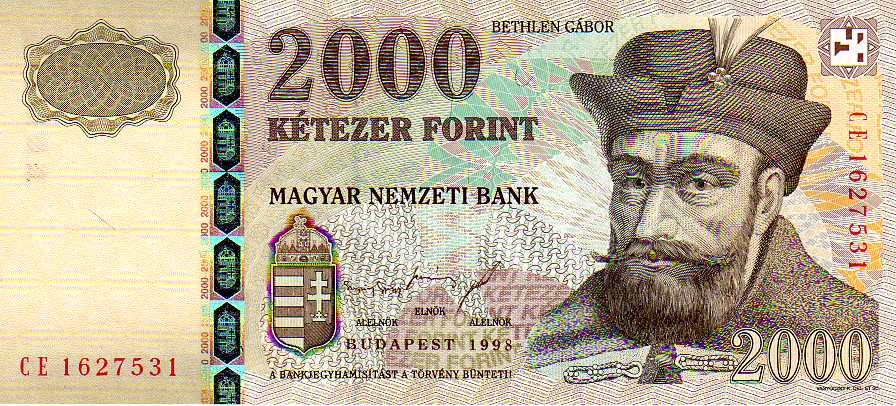
The portrait reproduces a contemporary likeness of the prince in three-quarter view, in fur-trimmed Transylvanian court dress.
Image: Magyar Nemzeti Bank, released for unrestricted reproduction within the limits of Hungarian anti-counterfeiting law.
Reverse: Bethlen among his scholars
The reverse reproduces Viktor Madarász's painting Bethlen Gábor a tudósok körében (Gabriel Bethlen among his Scholars), completed around 1870 and now in the Hungarian National Gallery. The scene shows the prince at a long table, leaning over an open book among the foreign humanists he had brought to Gyulafehérvár.
Bethlen founded the Collegium Academicum there in 1622, partly to spare the Calvinist nobility of Transylvania the cost of sending their sons to Heidelberg or Leiden.
The faculty was unusual for the region: Johann Heinrich Alsted, the German polymath whose seven-volume Encyclopaedia of 1630 is one of the founding works of the genre; his son-in-law Johann Heinrich Bisterfeld, who corresponded with Comenius and Hartlib; the philologist Ludwig Philipp Piscator; and, for a brief year, Martin Opitz, the reformer of German prosody.
Madarász painted the canvas at the close of his career; the harsh reception of its exhibition in 1873 prompted him to abandon painting and return to his father's business. The picture entered the canon of Hungarian historical painting only after his death in 1917.
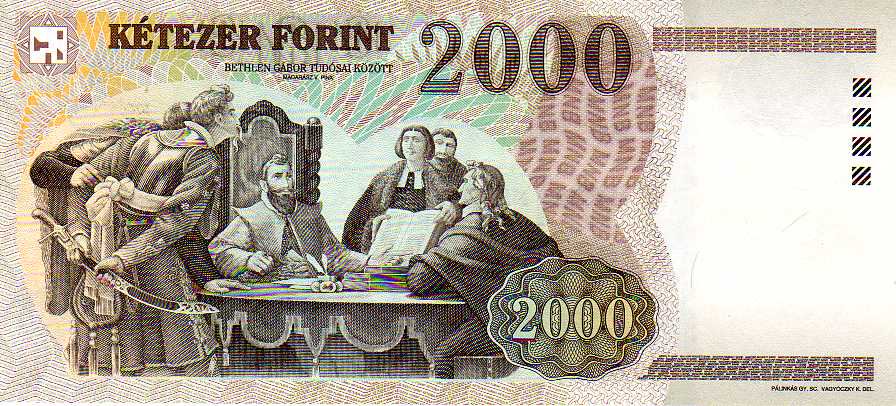
The note reproduces the central group of the composition; an inset shows an ornamental cartouche taken from a book printed at the Gyulafehérvár press.
Image: Magyar Nemzeti Bank, released for unrestricted reproduction within the limits of Hungarian anti-counterfeiting law.
5,000 forint
Obverse: István Széchenyi
Count István Széchenyi (1791–1860) was the leading reformer of the Hungarian Reform Era, called by his political rival Lajos Kossuth a legnagyobb magyar, "the greatest of the Hungarians."
Born in Vienna into one of the oldest Habsburg-loyal magnate families, Széchenyi served as a cavalry officer in the Napoleonic Wars; in October 1813 he carried Coalition dispatches across French-held territory to Blücher and Bernadotte, helping coordinate the junction of allied armies before the Battle of Leipzig.
Long visits to England in the 1820s convinced him that Hungary's feudal economy and Latin-language administration were holding the country back. He resigned his commission in 1826 to dedicate himself to reform.
In November 1825, at the Diet of Pressburg, Széchenyi pledged a full year's income from his estates, sixty thousand forints, to found a Hungarian learned society. The gift shamed other magnates into contributions and became the seed money for what is now the Hungarian Academy of Sciences.
His three pamphlets Hitel (Credit, 1830), Világ (Light, 1831) and Stádium (1833) attacked entailed estates, serfdom and the exemption of the nobility from taxation. He drove the construction of the Chain Bridge over the Danube at Pest-Buda (opened 1849) and launched steam navigation on the Danube and Lake Balaton.
His gradualist liberalism collided with Kossuth's revolutionary politics through the 1840s. He served as Minister of Public Works and Transport in the Batthyány cabinet of 1848, but in September suffered a mental collapse and entered a private asylum at Oberdöbling outside Vienna, where he continued to write polemics for the rest of his life.
He killed himself there on 8 April 1860 and was buried in the family mausoleum at Nagycenk.
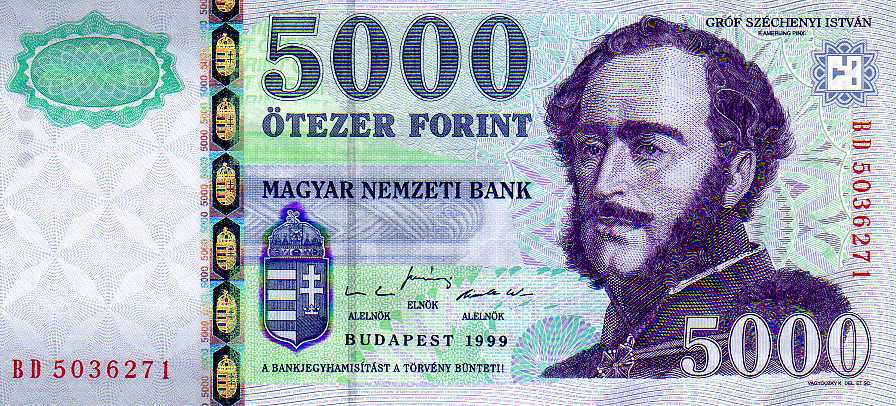
The portrait reproduces Friedrich von Amerling's 1836 oil of the Count at forty-five, painted at the zenith of his reform years and now in the art collection of the Hungarian Academy of Sciences.
Image: Magyar Nemzeti Bank, released for unrestricted reproduction within the limits of Hungarian anti-counterfeiting law.
Reverse: Széchenyi Mansion at Nagycenk
The reverse shows the Széchenyi family seat at Nagycenk, in the Sopron district of western Hungary near the Austrian border, the country residence of three generations of reforming Széchenyis.
The estate had belonged to the family since 1681. The present mansion, known locally as the régi kastély ("old palace"), was built in the Baroque style in the 1750s by General Antal Széchényi and his wife Zsuzsanna Barkóczy; its baroque chapel preserves a ceiling fresco by István Dorfmeister.
In 1799, István's father Ferenc Széchényi (the founder of the Hungarian National Museum and Library) ordered a moderate refurbishing that gave the façade its present neoclassical air. The palace park and the long avenue of lindens leading to the village were laid out at the same time.
After 1945 the family was expropriated and the mansion fell into disrepair under various state uses. It was restored in the 1970s and now houses the István Széchenyi Memorial Museum, run by the Eszterháza Cultural Centre, with the family mausoleum standing a short walk away. The mansion, park and linden alley have been part of the Fertő Area World Heritage Site since 2001.
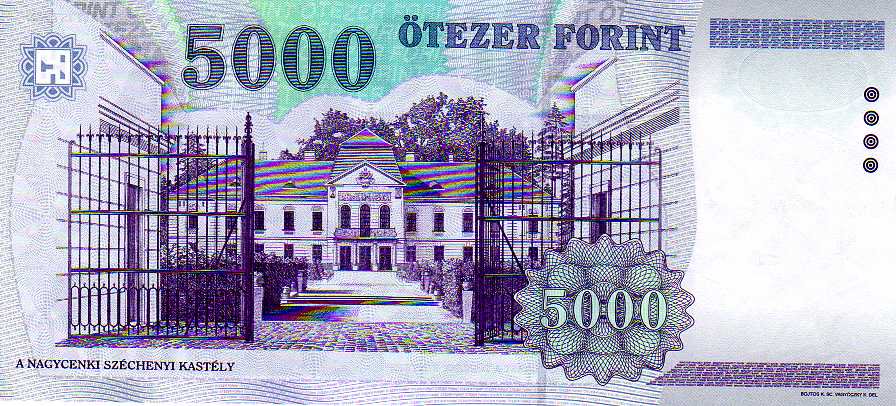
A view of the mansion's neoclassical garden front fills the note.
Image: Magyar Nemzeti Bank, released for unrestricted reproduction within the limits of Hungarian anti-counterfeiting law.
10,000 forint
Obverse: King Stephen I
King Stephen I (c. 975–1038), known to Hungarians as Szent István, "Saint Stephen," founded the Christian Kingdom of Hungary and gave the country the institutional shape it would keep for a thousand years.
Born as Vajk in Esztergom, son of Grand Prince Géza and the Transylvanian princess Sarolt, he was baptised in the German rite in early childhood and married the Bavarian princess Gisela in 996. He succeeded his father in 997 and crushed his pagan cousin Koppány, the candidate of the old magnate clans, at the Battle of Veszprém.
On Christmas Day 1000 (or 1 January 1001) he was crowned at Esztergom with a diadem reputedly sent by Pope Sylvester II, an act that gave the new kingdom independence from the Holy Roman Empire. He erected an archbishopric at Esztergom, nine further bishoprics and several Benedictine abbeys, including the still-functioning monastery at Pannonhalma.
He reorganised the country into royal counties run by an ispán, struck silver dinars stamped STEPHANUS REX that circulated as far north as Sweden, and codified law in two decretal books. In 1030 he repelled an invasion by Emperor Conrad II and forced the cession of border territory along the Leitha.
The death of his only surviving son Emeric in a hunting accident in 1031 broke both him and the dynasty. Stephen blinded his cousin Vazul to keep the throne from a pagan candidate and nominated his nephew Peter Orseolo, a choice that triggered three decades of civil war after his death on 15 August 1038. He was canonised in 1083 together with Emeric and Bishop Gerard of Csanád.
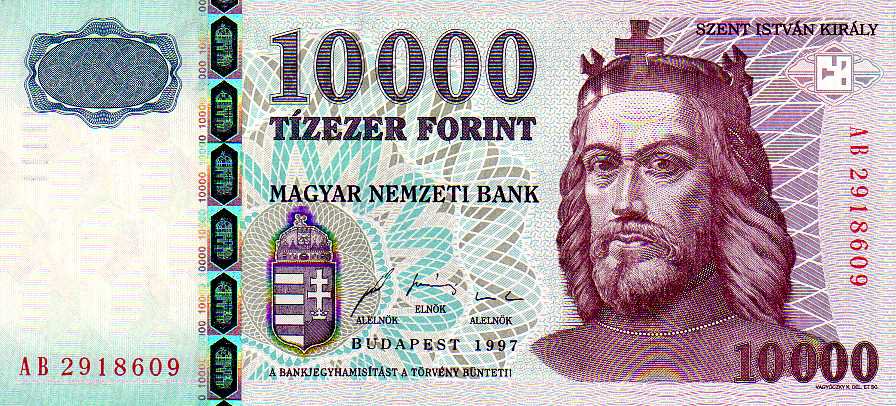
No contemporary portrait of Stephen survives; the figure on the note is an idealised medieval likeness of a crowned Árpád-dynasty king.
Image: Magyar Nemzeti Bank, released for unrestricted reproduction within the limits of Hungarian anti-counterfeiting law.
Reverse: View of Esztergom by Hubert Sattler
The reverse reproduces Hubert Sattler's panoramic View of Esztergom, painted around 1850 and now in the Christian Museum of Esztergom.
Esztergom was where Stephen was born, baptised and crowned, and remained the royal residence until Béla IV moved the seat of government to Buda after the Mongol invasion of 1241. The seat of the senior archbishopric of the Hungarian church has stayed there ever since.
The Basilica in the painting is not Stephen's church; the original cathedral, founded by Stephen and dedicated to St Adalbert, was destroyed during the Ottoman wars of the sixteenth century. The current building, the largest church in Hungary, was begun in 1822 under Archbishop Sándor Rudnay to designs by Pál Kühnel and János Packh, completed by József Hild, and consecrated in 1856 with a Missa solemnis by Franz Liszt.
Hubert Sattler (1817–1904), son of the Salzburg cosmorama painter Johann Michael Sattler, made his career producing highly detailed topographical panoramas of European and oriental cities for the family's travelling cosmorama show, where the canvases were displayed to a paying public through magnifying lenses.
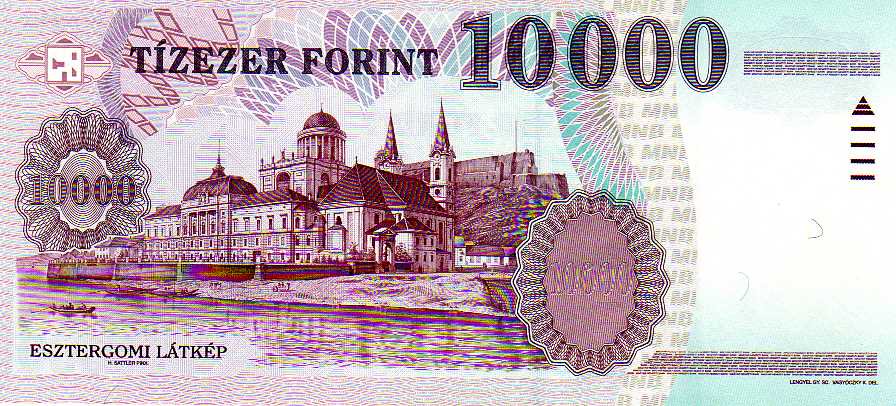
A wide view of Esztergom from across the Danube fills the note, with the dome of the Basilica centred on Castle Hill.
Image: Magyar Nemzeti Bank, released for unrestricted reproduction within the limits of Hungarian anti-counterfeiting law.
20,000 forint
Obverse: Ferenc Deák
Ferenc Deák (1803–1876), known across Hungary as a haza bölcse, "the Sage of the Nation," was the lawyer who reassembled the Hungarian constitution after the defeat of 1849 and negotiated the Compromise of 1867 that defined the country's place in Europe until 1918.
Born to the lesser Catholic nobility of Zala County, he was trained in law, served as a deputy of the Reform Diet from 1832, and by 1840 had become the recognised leader of the moderate liberal opposition. He served as Minister of Justice in Lajos Batthyány's revolutionary government of 1848 and drafted parts of the April Laws that converted Hungary into a parliamentary state.
After the collapse of the revolution in 1849 he withdrew to his estate at Kehida, and from his rooms at the Queen of England hotel (Angol Királynő) in Pest he taught the country the practice of passive resistance: refusing to pay illegal taxes, refusing to take up office under the Habsburg neo-absolutist administration, and refusing to recognise the territorial reorganisation of 1850.
His "Easter Article" of 16 April 1865, published anonymously in the Pesti Napló, broke the deadlock; it offered the dynasty a deal under which Hungary would accept the union of crowns but reclaim its 1848 constitution. The Compromise (Ausgleich) of 1867, the product of two years of negotiation, founded the dual monarchy of Austria-Hungary.
Deák refused the prime ministership and every other high office. He lived modestly, kept a flock of pet birds in his hotel rooms, and died of a long illness on 28 January 1876. The state funeral and burial in Kerepesi Cemetery in Pest were attended by tens of thousands.
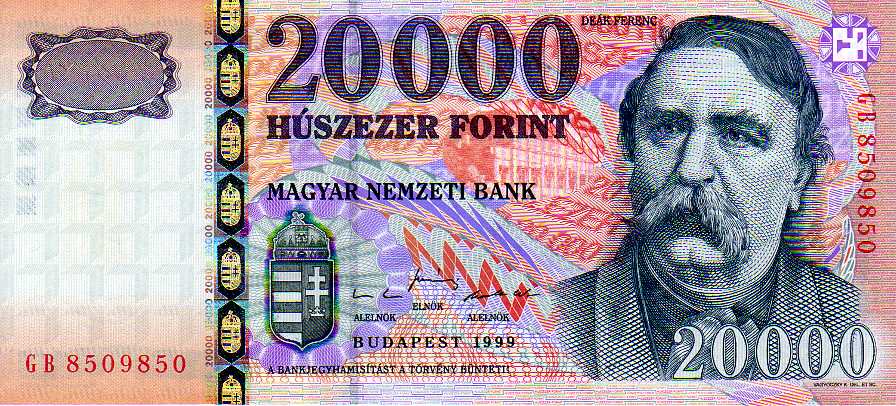
The portrait shows Deák in late middle age, in the dark coat he habitually wore.
Image: Magyar Nemzeti Bank, released for unrestricted reproduction within the limits of Hungarian anti-counterfeiting law.
Reverse: Old House of Representatives in Pest
The reverse shows the Old House of Representatives at 8 Bródy Sándor utca in Budapest, the building put up in haste to give the post-Compromise Hungarian parliament a home.
The resurrected lower house had nowhere to meet. The Diet had previously sat in Pressburg or, for shorter sessions, in the Hungarian National Museum, neither of which was suitable for a permanent parliament of nearly four hundred and fifty deputies.
In 1865, even before the Compromise was signed, the government commissioned the architect Miklós Ybl to design a "temporary" building on the block behind the National Museum. Construction began on 11 September and the new chamber was occupied on 14 December: barely three months, with eight hundred workers labouring in shifts.
Ybl produced a sober Neo-Renaissance volume with a giant Corinthian portico to the street, a coffered semicircular debating chamber inside, and lobbies along the long axis. The House of Representatives met here from December 1865 until 1902, when Imre Steindl's monumental Parliament on the Danube was ready and the wooden interior fittings were carried over to it.
The upper house continued to meet at the National Museum throughout this period. The old chamber later housed various tenants and has been the home of the Istituto Italiano di Cultura, Budapest's Italian Cultural Institute, since 1943.
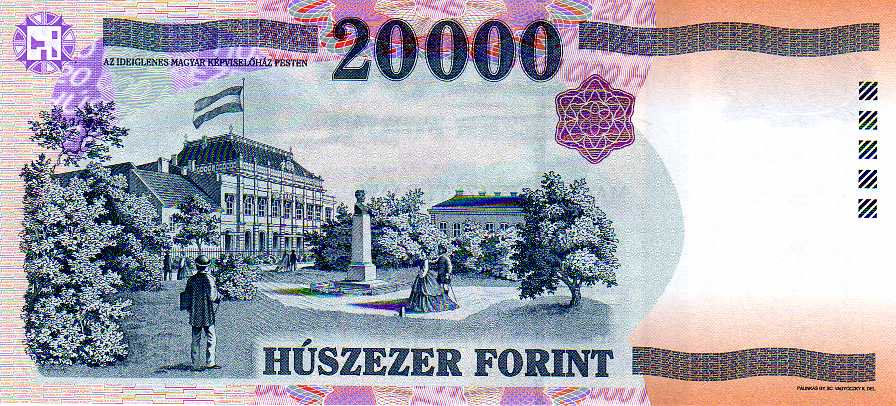
A frontal view of the building's portico fills the note.
Image: Magyar Nemzeti Bank, released for unrestricted reproduction within the limits of Hungarian anti-counterfeiting law.