The current series of Serbian dinar banknotes was introduced by the National Bank of Serbia between 2003 and 2011, in the years following the breakup of Yugoslavia and a decade of hyperinflation. Its nine denominations honour figures from 19th- and 20th-century Serbian cultural and scientific life: a linguist, a prince-bishop poet, a composer, an inventor, a painter, a geographer, an industrialist, an astronomer, and a historian.
The designs are inherited from the 2000–2002 Yugoslav dinar: same engravings, new state name. For the year-by-year rollout, the constitutional context and the Topčider printing plant, see The current series (2003–2011).
10 dinars
Obverse: Vuk Karadžić
Vuk Stefanović Karadžić (1787–1864) was the philologist who reformed written Serbian. He standardised the Cyrillic alphabet on phonemic principles, compiled the first dictionary of the modern language, translated the New Testament into vernacular Serbian (1847), and gathered the folk songs and tales that drew the attention of Goethe, Jacob Grimm and Pushkin to South Slavic culture. Prince Miloš Obrenović initially banned most of his works, fearing that promoting the people's language would undermine accommodations with the Ottomans; the Imperial Academy of Vienna and the Russian Emperor, who elected and pensioned him, told the opposite story.
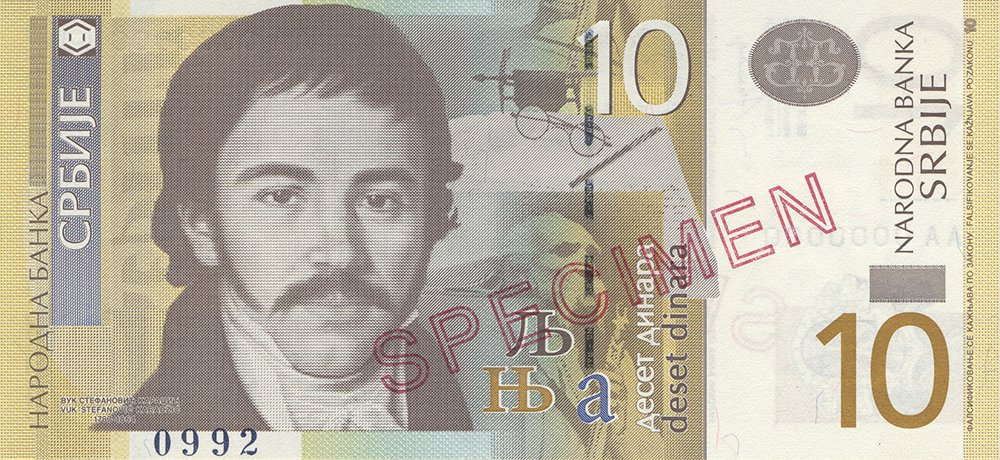
The portrait sits beside Karadžić's writing kit and an open book, both exhibits from the Vuk Karadžić and Dositej Obradović Museum in Belgrade. Three letters of the reformed Cyrillic alphabet appear in the lower right.
Image: National Bank of Serbia, public domain (PD-SerbiaGov).
Reverse: First Slavic Congress (1848)
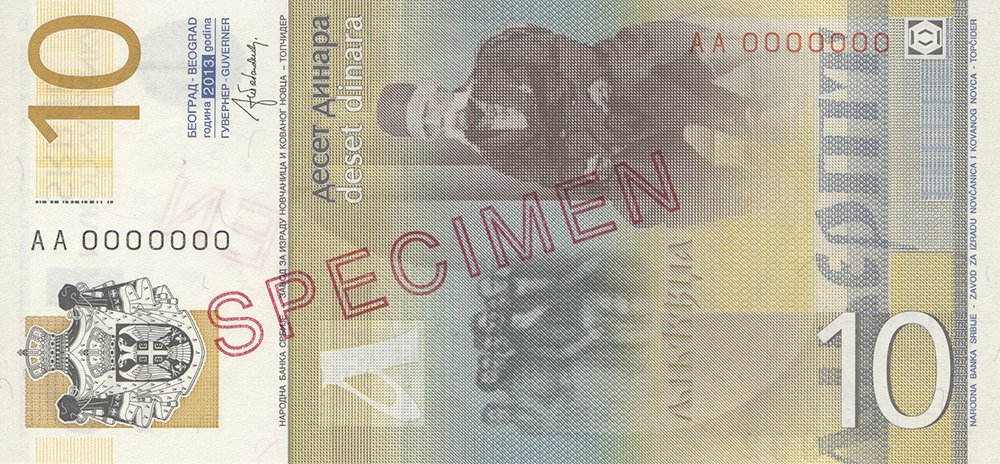
The reverse pairs Karadžić's portrait with a scene of the First Slavic Congress, held in Prague between 2 and 12 June 1848. The Congress was the first gathering of representatives from nearly all Slavic peoples of Europe and produced a "Manifesto to the Nations of Europe" demanding an end to Slavic oppression; it ended abruptly when Austrian troops fired on protesters during the Prague Uprising. Karadžić himself is not listed among the 340 delegates in surviving records, but by 1848 he had become the most internationally recognised figure of the South Slavic cultural awakening that the Congress sought to channel into politics.
A vignette of three letters from the reformed alphabet repeats below the scene, and the great coat of arms of the Republic of Serbia sits in the upper-left corner against an ochre background.
Image: National Bank of Serbia, public domain (PD-SerbiaGov).
20 dinars
Obverse: Petar II Petrović-Njegoš
Petar II Petrović-Njegoš (1813–1851), born Radivoje Petrović in the village of Njeguši, was prince-bishop (vladika) of Montenegro from 1830 until his death at thirty-seven. The vladika's office combined the leadership of the Serbian Orthodox metropolitanate of Cetinje with secular rule over the Montenegrin clans, a fusion of priesthood and statecraft unique among Orthodox jurisdictions. Consecrated Metropolitan in St. Petersburg in 1833, he introduced the first regular taxation, the first elementary schools, a printing press and the secular palace known as the Biljarda, while writing the poetry that made him the central literary figure of the South Slavs in the 19th century. His best-known work, the dramatic poem Gorski vijenac (The Mountain Wreath, 1847), is celebrated as a national epic of Montenegro and Serbia and read with discomfort today for its unsparing depiction of seventeenth-century violence against Slavic Muslim converts. He died of tuberculosis at Cetinje and was eventually reburied in a mausoleum on Mount Lovćen designed by Ivan Meštrović.
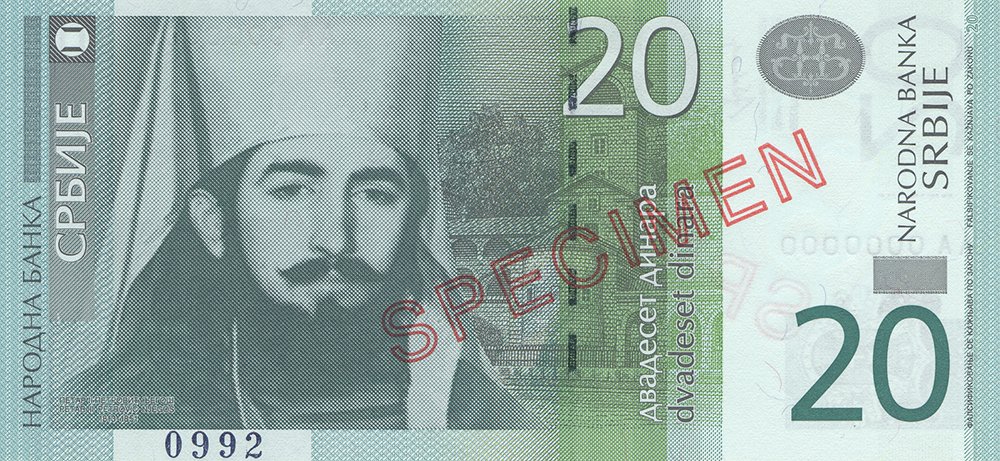
The portrait is paired with a small sketch of the Monastery of Cetinje, the spiritual centre of Montenegro and Njegoš's ecclesiastical seat as Metropolitan.
Image: National Bank of Serbia, public domain (PD-SerbiaGov).
Reverse: Cetinje Octoechos (1494) and the Komovi
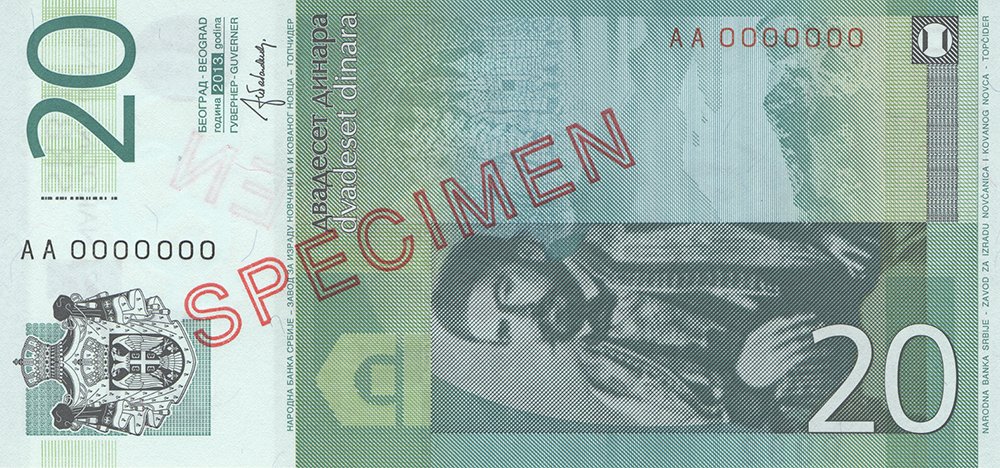
Behind a second image of Njegoš, the reverse shows a decorative miniature from the Cetinje Octoechos, printed in 1494 in the Crnojević printing house at Cetinje. It is the first book printed in any South Slavic language; the press operated for only a few years before the Ottomans burned Cetinje in 1499 and the type was reportedly melted down for cannon shot. The mountain range to the right is the Komovi, on the border between Montenegro and Albania, in the country Njegoš ruled and described in his poetry. The great coat of arms of the Republic of Serbia sits in the upper-left corner against a green background.
Image: National Bank of Serbia, public domain (PD-SerbiaGov).
50 dinars
Obverse: Stevan Stojanović Mokranjac
Stevan Stojanović Mokranjac (1856–1914), born in Negotin in eastern Serbia and dead at fifty-eight in Skopje as the First World War broke out, is the founding figure of modern Serbian art music. Trained in Munich under Joseph Rheinberger, in Rome under Alessandro Parisotti, and in Leipzig under Carl Reinecke, he applied a conservative European harmonic technique to material gathered on field trips through Serbia, Macedonia, Kosovo, Bosnia and what was then called Old Serbia. The result was the cycle of fifteen Rukoveti ("Garlands"), eighty-two folk songs arranged for a cappella choir between 1883 and 1913 and still the core repertoire of every Serbian choral society. He led the Belgrade Choral Society from 1887 until his death, founded the Serbian School of Music in 1899 (renamed for him after his death), and standardised the chants of the Serbian Orthodox Church in his 1908 Osmoglasnik, which remained the seminary textbook between the wars.
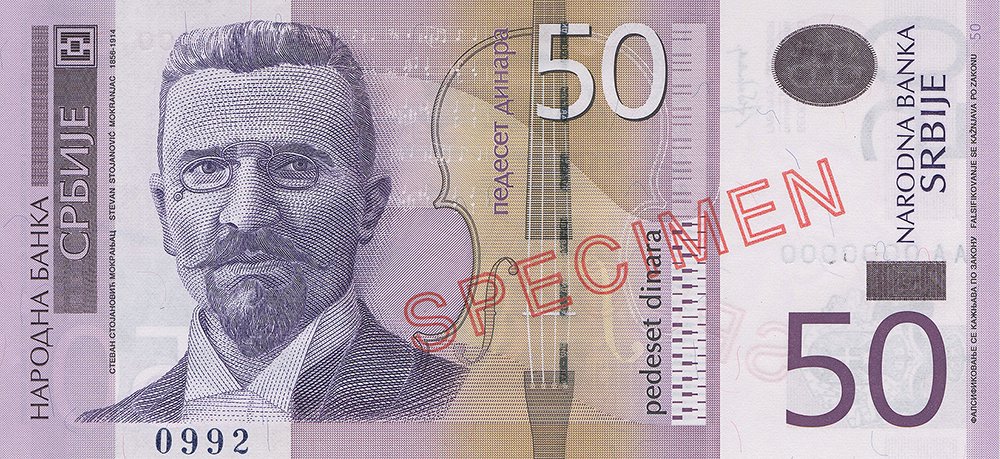
The portrait sits beside a violin and a keyboard, his instruments as performer and composer, and pages of manuscript score from the Mokranjac Legacy collection.
Image: National Bank of Serbia, public domain (PD-SerbiaGov).
Reverse: Miroslav Gospel and the choral score
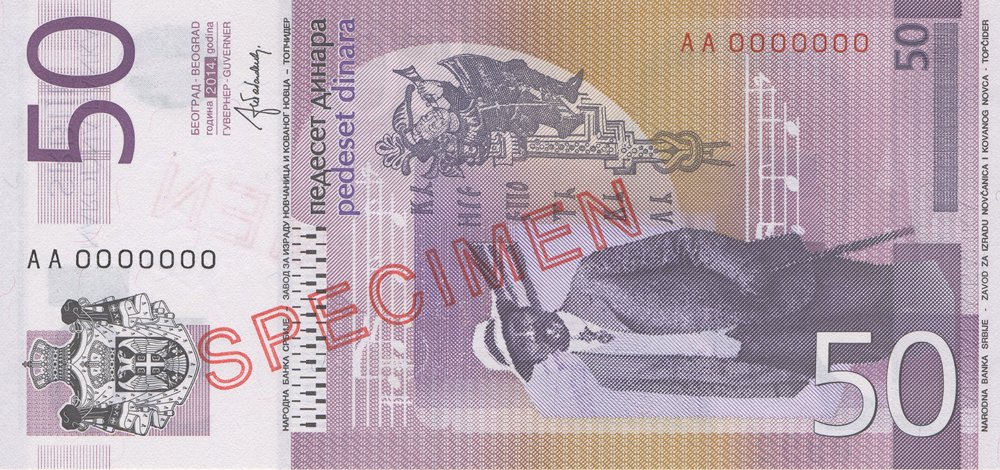
Behind a second image of Mokranjac, the reverse shows an illuminated initial from the Miroslav Gospel, a Cyrillic manuscript of the Four Gospels commissioned around 1180 by Prince Miroslav of Hum and one of the oldest surviving works of Serbian literature. The pairing is iconographic rather than biographical: there is no record that Mokranjac set the manuscript to music. The two stand on the note as the country's most prominent works of medieval and modern artistic life, joined by lines of choral score and the great coat of arms of the Republic of Serbia in the upper-left corner against a violet background.
Image: National Bank of Serbia, public domain (PD-SerbiaGov).
100 dinars
Obverse: Nikola Tesla
Nikola Tesla (1856–1943), born in Smiljan in the Military Frontier of the Austrian Empire (today in Croatia) to an Orthodox priest of Serbian descent, was the engineer who made high-voltage alternating current practical and, with it, the modern electrical grid. He emigrated to New York in June 1884 with a letter of introduction to Thomas Edison, quit Edison Machine Works after six months over an unpaid bonus, and patented the alternating-current induction motor in 1888. George Westinghouse bought the rights for $60,000 plus per-motor royalties, later renegotiated, and finally a flat $216,000 for the patent itself. The rest of Tesla's life was a slow descent from this peak: the wireless-transmission tower at Wardenclyffe (1901–1905), funded by J. P. Morgan and intended to send electricity across the Atlantic, collapsed for lack of money and was eventually demolished. By the 1930s he was living in Manhattan hotels on a $125 monthly retainer that Westinghouse Electric called "consulting" to spare him the indignity of charity. He died at the Hotel New Yorker in January 1943, eighty-six years old.
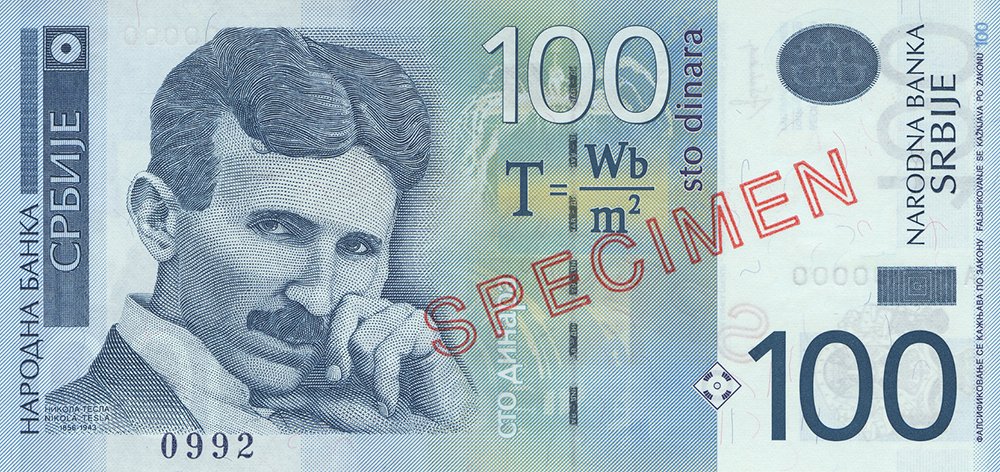
The portrait sits against a faint image of an electric discharge, a visible signature of Tesla's high-voltage experiments, alongside a formula for magnetic flux density. The SI unit of that quantity was named the tesla in his honour by the General Conference on Weights and Measures in 1960.
Image: National Bank of Serbia, public domain (PD-SerbiaGov).
Reverse: AC induction motor and the white pigeon
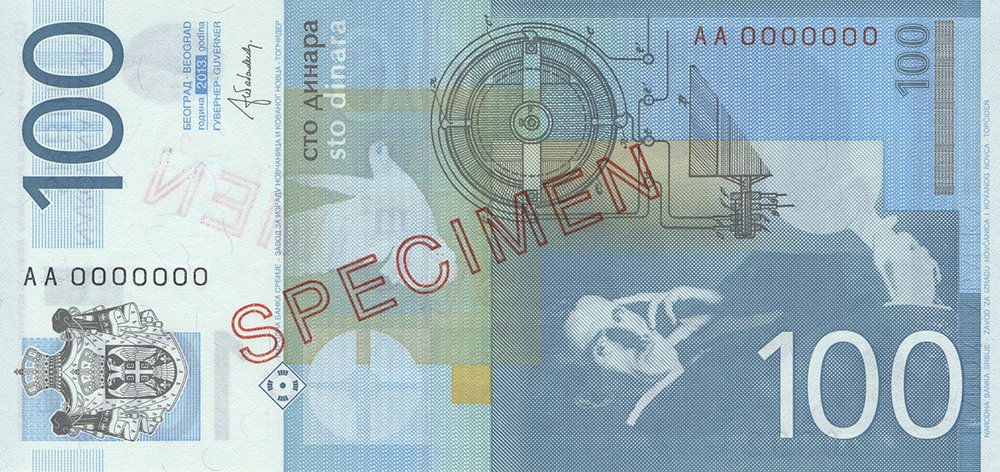
Behind a museum photograph of Tesla, the reverse shows a sketch of the alternating-current induction motor patented in 1888, the machine that ended the war of the currents in his favour and made it possible to send electricity hundreds of miles. To the right flies a white pigeon, a reference to a particular bird Tesla nursed in his New York hotel rooms and is reported to have loved more than any human being; biographer John J. O'Neill records that he spent over $2,000 on a custom-built device to support her broken wing and leg. The great coat of arms of the Republic of Serbia sits in the upper-left corner against a blue background.
Image: National Bank of Serbia, public domain (PD-SerbiaGov).
200 dinars
Obverse: Nadežda Petrović
Nadežda Petrović (1873–1915), born in Čačak and trained in Munich under the Slovenian painter Anton Ažbe, is the foundational figure of Serbian modernism. Her years at the Ažbe school placed her among Wassily Kandinsky, Alexej von Jawlensky and Paul Klee at the moment European painting was breaking away from naturalism; she returned to Belgrade in 1900 carrying that break with her, painted in styles that ran from secession through impressionism to fauvism, and helped organise the First Yugoslav Art Exhibition and the First Yugoslav Art Colony. When the First Balkan War began in 1912 she joined the Serbian army as a volunteer nurse, was decorated with the Medal for Bravery and the Order of the Red Cross, contracted typhus and cholera in 1913, recovered, and returned to nursing duty when the First World War reached Serbia. She died of typhus at the Valjevo military hospital on 3 April 1915, forty-one years old. Her younger brother Rastko Petrović became one of the leading writers of interwar Serbia.
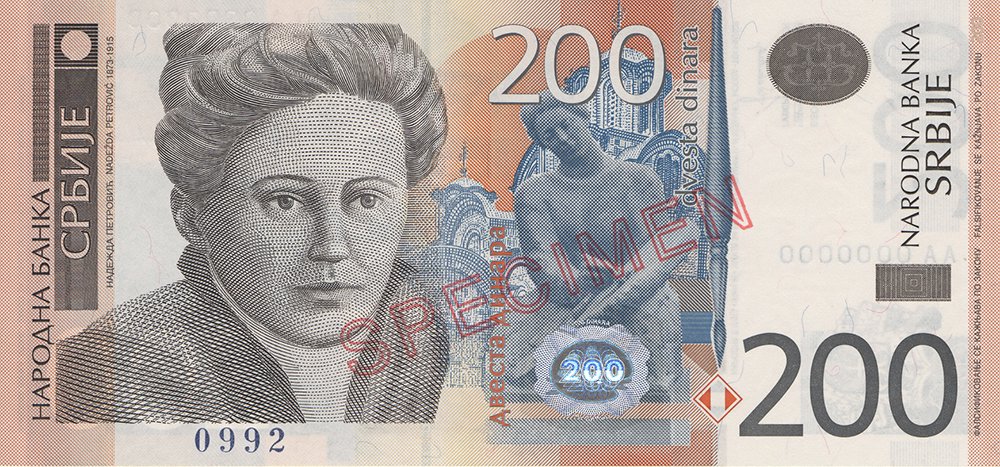
The portrait is paired with a sculpture of the artist, a painter's brush and a silhouette of the Gračanica Monastery in Kosovo, which she painted repeatedly between 1908 and 1913 in increasingly bold colour.
Image: National Bank of Serbia, public domain (PD-SerbiaGov).
Reverse: Petrović as nurse in the First Balkan War
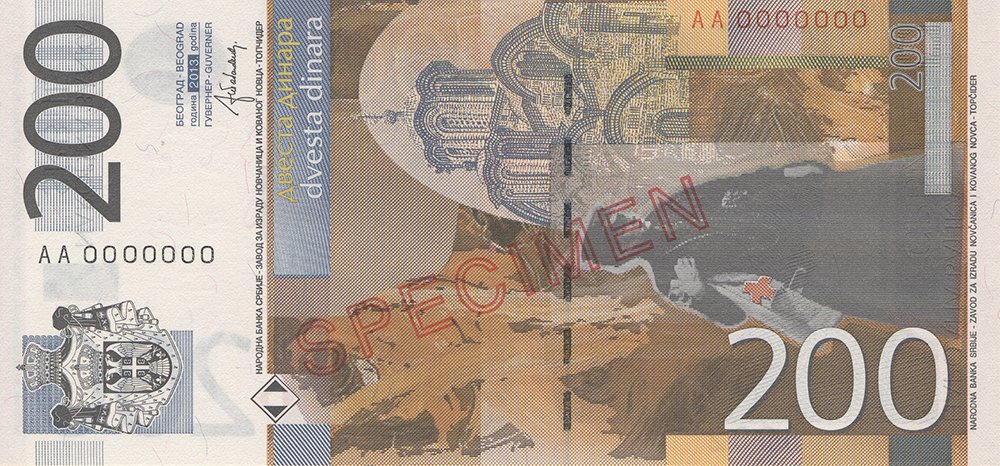
The reverse shows Petrović in the uniform of a Serbian Red Cross nurse, against the same Gračanica silhouette and a fragment of one of her own canvases. The note presents both halves of her career: the painter who brought European modernism to Serbia and the woman who walked away from her studio twice to nurse wounded soldiers, the second time fatally. The great coat of arms of the Republic of Serbia sits in the upper-left corner against an amber-red background.
Image: National Bank of Serbia, public domain (PD-SerbiaGov).
500 dinars
Obverse: Jovan Cvijić
Jovan Cvijić (1865–1927), born in Loznica in western Serbia, was the geographer who turned the Balkans into a research subject. His Vienna doctorate of 1893, Das Karstphänomen, supervised by Albrecht Penck, founded karst geomorphology as a discipline and introduced the term doline for the closed depressions in limestone landscapes that had been known to Dinaric peasants for centuries without a name. He founded the Serbian Geographical Society in Belgrade in 1910, served twice as rector of Belgrade University (1906–1907 and 1919–1920), and presided over the Serbian Royal Academy from 1921 until his death. His ethnographic monograph Balkansko poluostrvo ("The Balkan Peninsula") used human geography to map the cultural and ethnic patterns of South-East Europe; he carried the same maps and methods to the Paris Peace Conference in 1919 as a border expert for the new Kingdom of Serbs, Croats and Slovenes, where they were used to draw frontiers around Banat, Bačka, Baranya and Carniola. Modern historians have noted that his classification of Macedonian Slavs, Šopi and Torlaks as Serbs rather than Bulgarians remains contested.
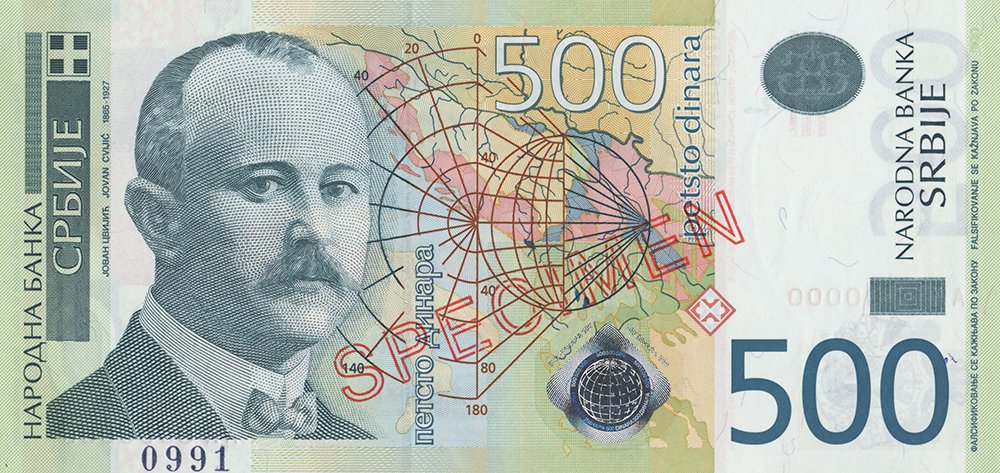
Image: National Bank of Serbia, public domain (PD-SerbiaGov).
Reverse: Cvijić and the ethnographic motif
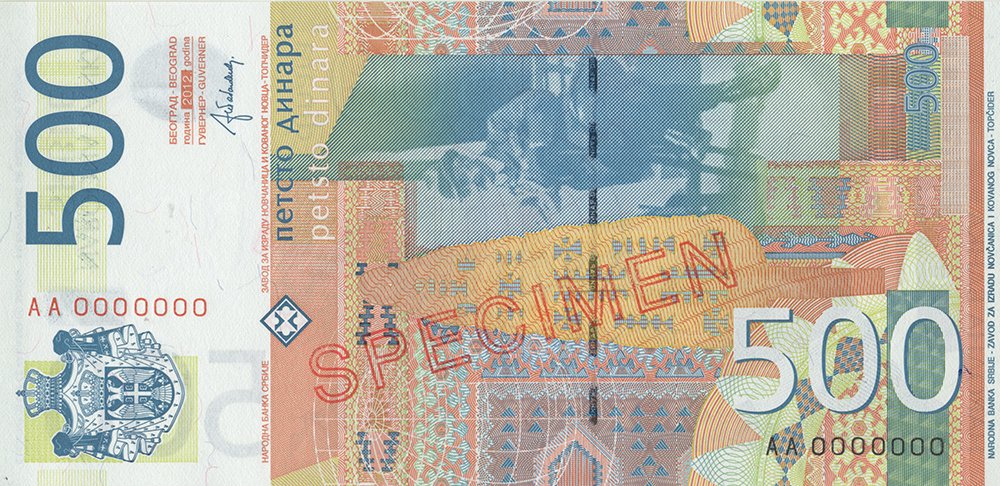
Unusually for the series, the reverse of the 500-dinar note is printed vertically. It shows Cvijić seated with a cane against a background of stylised ethnographic motifs drawn from South Slavic folk decoration; these are the visual shorthand for the discipline he applied to the Balkans on the political map of 1919. The great coat of arms of the Republic of Serbia sits in the upper left corner against a blue-green background.
Image: National Bank of Serbia, public domain (PD-SerbiaGov).
1,000 dinars
Obverse: Đorđe Vajfert
Đorđe Vajfert (Georg Weifert in German; 1850–1937), born in Pančevo to a Danube Swabian family of merchants, was the industrialist who built modern Serbia's mining sector and twice ran its central bank. He inherited the Weifert Brewery in Belgrade, which his father and grandfather had bought in 1865 and which became one of the largest in the Balkans, and used the profits to acquire the coal mines of Kostolac, the gold and copper mines of eastern Serbia and, decisively, the copper mines at Bor, the largest copper deposit in Europe. He served as governor of the National Bank of Serbia from 1890 to 1902 and again from 1912; the second tenure carried him through the First World War and the foundation of the Kingdom of Serbs, Croats and Slovenes, on whose behalf he managed the politically explosive conversion of Austro-Hungarian crowns into dinars at rates that disadvantaged former Habsburg citizens. He died in his Belgrade villa on 12 January 1937 and was buried in the Catholic cemetery in Pančevo, where he was born.
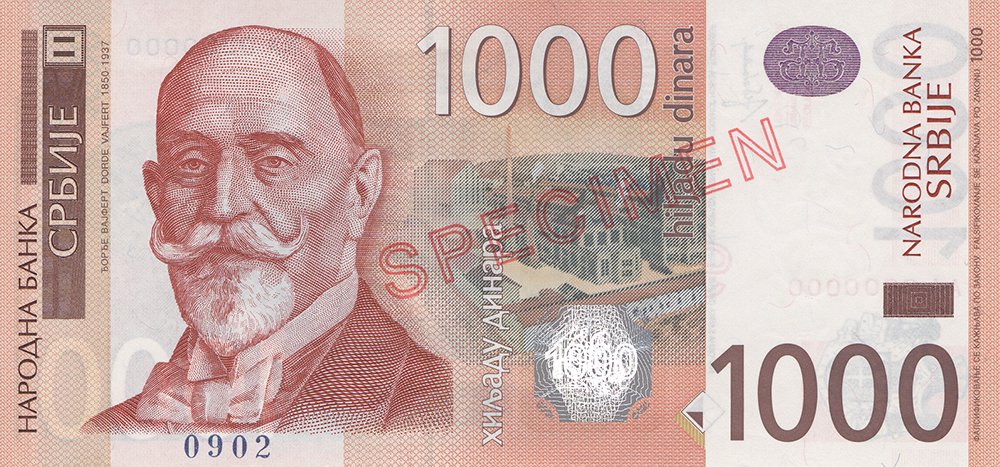
The portrait is paired with an outline of the Weifert Brewery in Belgrade, the family business that financed his entry into mining and banking.
Image: National Bank of Serbia, public domain (PD-SerbiaGov).
Reverse: National Bank interior and the medal of St George
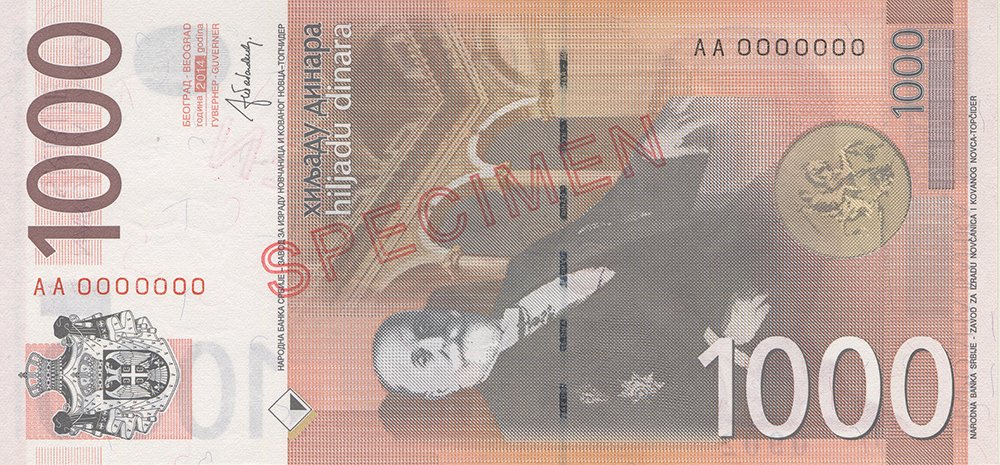
The reverse, like the 500, is printed vertically. Vajfert is shown against the decorated interior of the main hall of the National Bank of Serbia in Belgrade, the institution he led for a total of nineteen years across two terms. In the lower portion, Saint George slays the dragon, the religious namesake of Vajfert's first name (Đorđe is the Serbian form of George). A second medal shows the mounted figure of Karađorđe Petrović, leader of the First Serbian Uprising and the figure on the Order of Karađorđe's Star, one of Vajfert's decorations. The seal of the National Bank and the great coat of arms of the Republic of Serbia sit in the upper-left corner, against a bright red background.
Image: National Bank of Serbia, public domain (PD-SerbiaGov).
2,000 dinars
Obverse: Milutin Milanković
Milutin Milanković (1879–1958), born in Dalj on the Danube and dead in Belgrade at seventy-nine, took a Vienna doctorate in civil engineering in 1904 and joined the University of Belgrade as professor of applied mathematics in 1909. Arrested in Austria-Hungary at the outbreak of the First World War as a Serbian reserve officer, he spent four years interned in Budapest and used the time to begin a mathematical theory of solar radiation and Earth's climate. The work culminated in 1941 with his Canon of Insolation and the Ice Age Problem, a 626-page treatise printed in Belgrade and submitted four days before the Luftwaffe bombed the printing house; the bound sheets in the warehouse survived undamaged. Milanković argued that three slow variations in Earth's orbit and rotation control the solar energy reaching the high latitudes and so drive the rhythm of ice ages: the eccentricity of the orbit, the tilt of the axis, and the precession of the equinoxes. Geological orthodoxy ignored him for decades; deep-sea sediment cores in the 1970s confirmed the cycles, which now bear his name. He also drafted the Revised Julian calendar adopted by several Eastern Orthodox churches in 1923, with a leap-year rule slightly more accurate than the Gregorian.
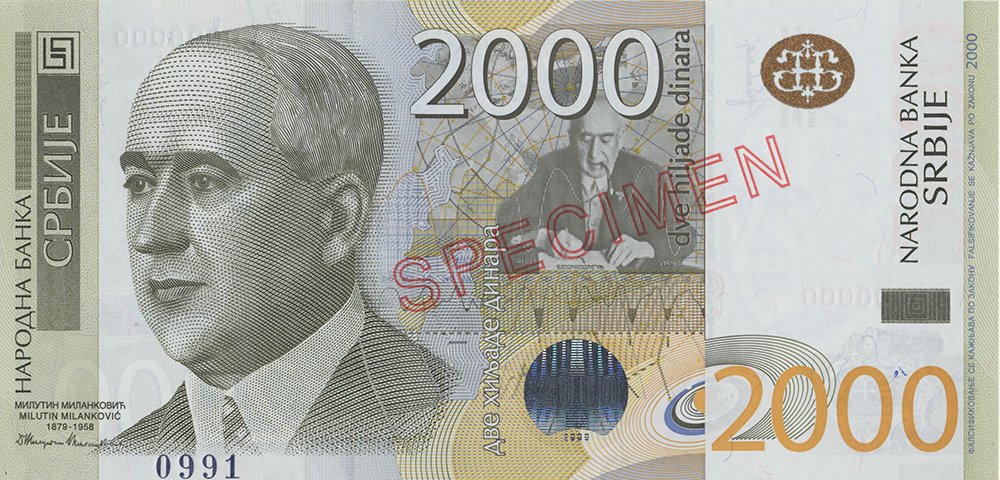
Behind the portrait, a faint vignette shows Milanković seated at his work desk smoking a pipe, with a graph plotting the migration of the snow line over the last 600,000 years, one of the curves the Canon of Insolation derived from his orbital calculations.
Image: National Bank of Serbia, public domain (PD-SerbiaGov).
Reverse: The path of the North Celestial Pole
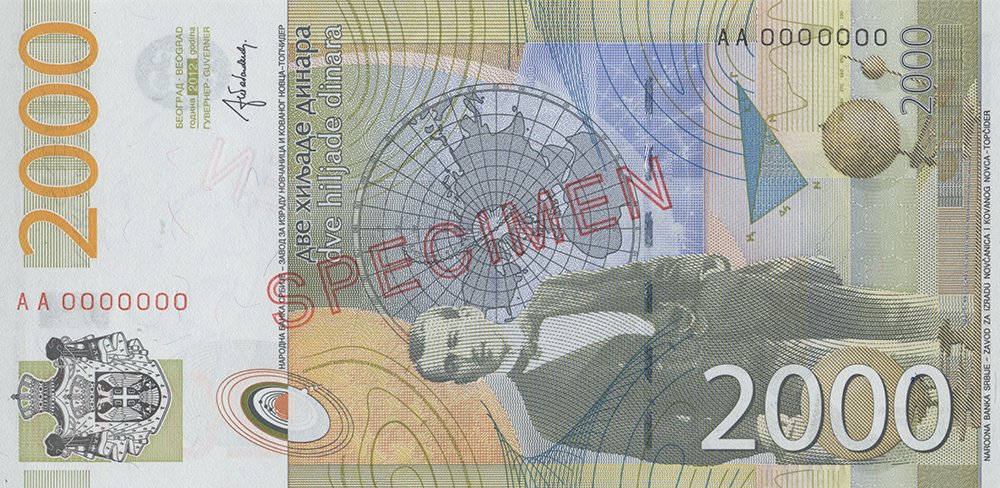
The reverse shows Milanković against a fragment of a stylised solar disc and a circular diagram from his book The Path of the North Celestial Pole. The diagram traces the slow loop that Earth's rotational axis describes among the stars during one cycle of axial precession, about 26,000 years long. Today the axis points near Polaris in Ursa Minor; twelve thousand years ago it pointed near Vega in Lyra, and in twelve thousand years it will return there. This precession, together with the slow change of axial tilt and orbital eccentricity, makes up the cycles that bear his name. The great coat of arms of the Republic of Serbia sits in the upper-left corner against an olive background.
Image: National Bank of Serbia, public domain (PD-SerbiaGov).
5,000 dinars
Obverse: Slobodan Jovanović
Slobodan Jovanović (1869–1958), born in Novi Sad and dead in London at eighty-nine, was Serbia's leading constitutional historian and the only figure on the current banknote series to have held high political office. He studied law in Munich, Zürich, Geneva and Paris, joined the Belgrade University Faculty of Law in 1897 and remained there until 1940, twice serving as rector and later as president of the Serbian Royal Academy. His scholarship reshaped the writing of nineteenth-century Serbian history through multi-volume political biographies of Karađorđe, Miloš Obrenović, Mihailo, Milan and Aleksandar Obrenović, treating each reign as a problem in constitutional law. After the 27 March 1941 military coup that overturned Yugoslavia's accession to the Tripartite Pact, he served as deputy prime minister and then, from 11 January 1942 to 26 June 1943, as prime minister of the Yugoslav government-in-exile in London. The communist regime that took power in 1945 sentenced him in absentia to twenty years' imprisonment and stripped him of citizenship and property; he never returned, dying in London in 1958. He was rehabilitated in Serbia in 1989; his remains were returned to Belgrade in 2011 and now lie on a plateau named for him in front of the Faculty of Law where he had taught.
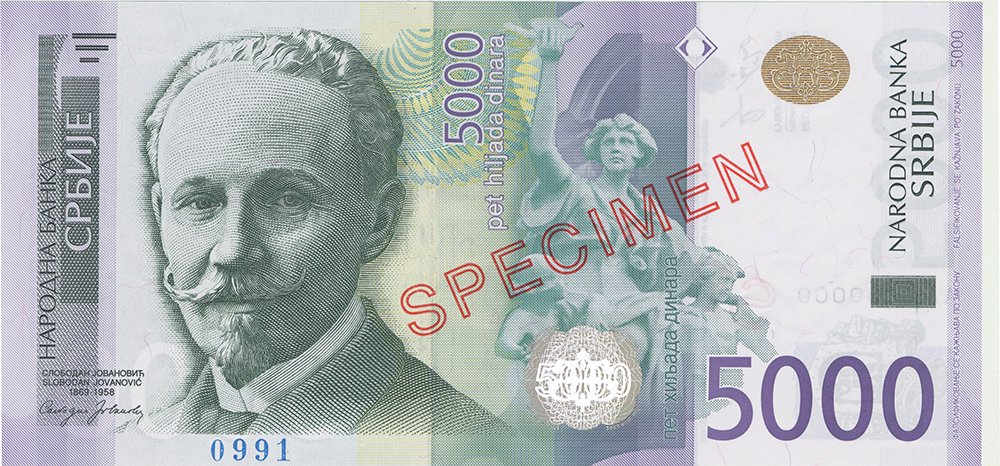
Image: National Bank of Serbia, public domain (PD-SerbiaGov).
Reverse: House of the National Assembly
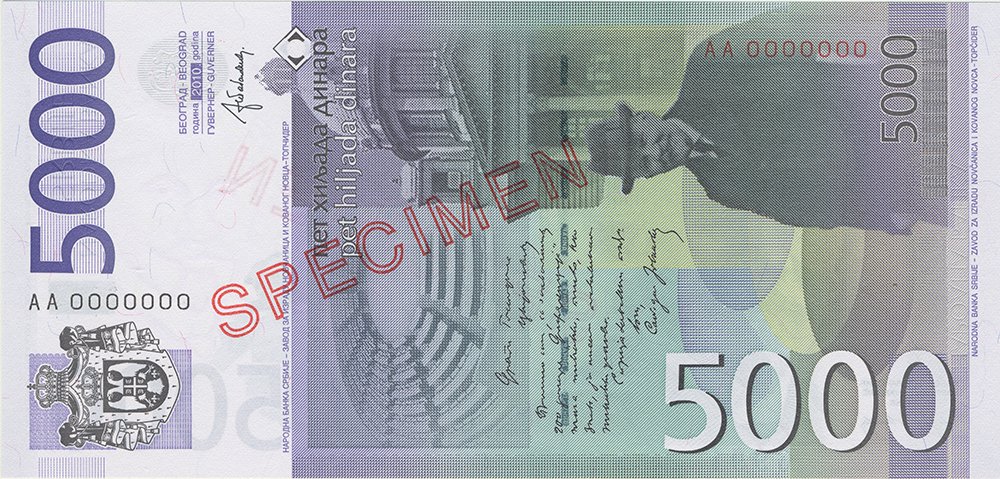
Behind a second image of Jovanović, the reverse shows the silhouette of the House of the National Assembly in Belgrade, completed in 1936 and known under socialism as the Federal Parliament of Yugoslavia. An architectural detail from its interior runs along the lower edge. The choice ties Jovanović to the institution he studied as a constitutional lawyer all his life and never sat in: when the parliament he advised in exile was dissolved by Tito's communists in 1945, the building continued without him. The great coat of arms of the Republic of Serbia and the seal of the National Bank sit in the upper-left corner against a mauve background.
Image: National Bank of Serbia, public domain (PD-SerbiaGov).